

-
Research Article
-
사헬 지역의 지표-대기 상호작용 - 식생 피복 변화와 아프리카 동풍 제트 -
Land-Atmosphere Interactions in the Sahel Region: Focusing on Vegetation Dynamics and African Easterly Jet
-
이민철, YadavShobha, 이은걸
Mincheol Lee, Shobha Yadav, Eungul Lee
- 사헬 지역은 서아프리카 여름 몬순(West African Summer Monsoon, WASM)과 아프리카 동풍 제트(African Easterly Jet, AEJ)의 강도에 의해 강수 변동성이 크게 나타나는 지역이다. …
The Sahel region experiences significant rainfall variability driven by the West African Summer Monsoon (WASM) and the African Easterly Jet (AEJ). This …
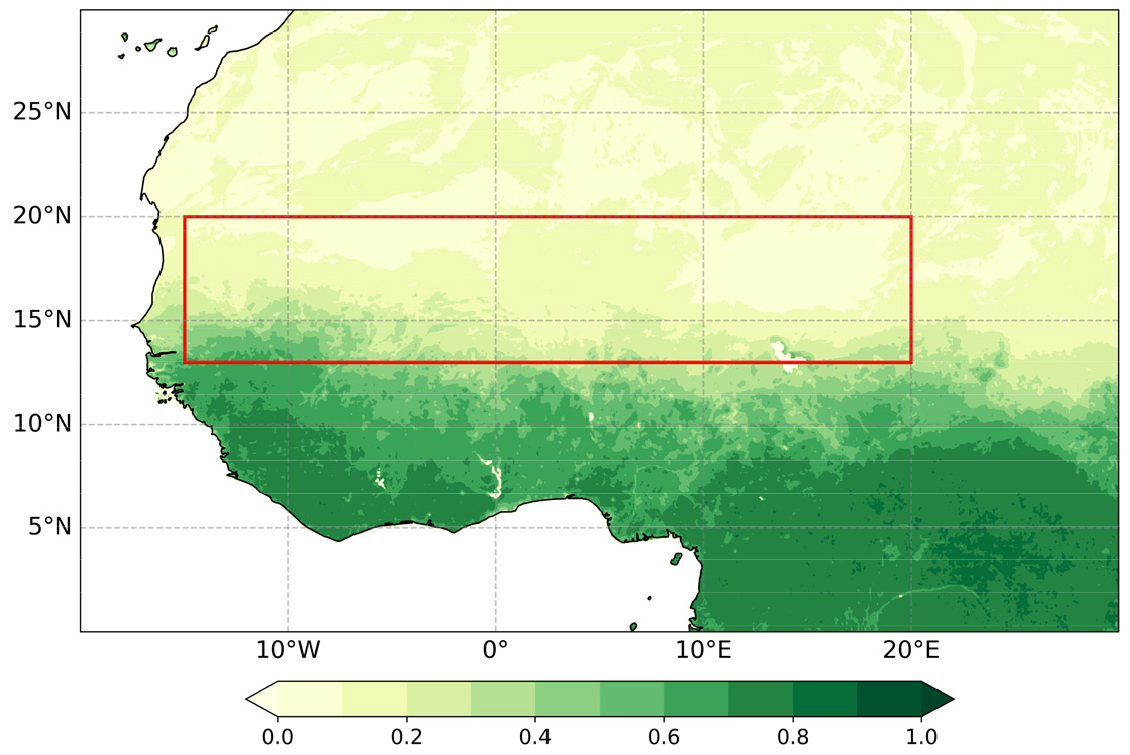
- 사헬 지역은 서아프리카 여름 몬순(West African Summer Monsoon, WASM)과 아프리카 동풍 제트(African Easterly Jet, AEJ)의 강도에 의해 강수 변동성이 크게 나타나는 지역이다. 본 연구는 1982년부터 2022년까지 지표-대기 상호작용의 관점에서 사헬 지역의 여름철(6~9월) 식생 피복 변화가 강수 변동성에 주는 영향을 확인하고 생지물리적(Biogeophysical) 프로세스를 제안하였다. 고해상도의 위성 기반 자료와 5세대 기후 재분석 자료를 활용하여 선형 회귀 분석, 상관 분석, 합성 편차 분석, Granger 인과성 분석을 수행하였다. 정규식생지수(Normalized Difference Vegetation Index, NDVI)는 다소 증가하는 추세를 보였으며, 총증발산량, 잠열 플럭스, 2m 비습과 양의 상관관계, 현열 플럭스, 2m 기온과는 음의 상관관계를 가졌다. 이러한 지표의 열 및 수분 수지 변화는 대기에 영향을 주고 연직 기온 및 지위고도를 감소시켜 AEJ의 약화 및 북상, WASM의 강화로 이어졌다. 이로 인해 강수량이 증가하고 다시 식생 활력도가 증가할 수 있다. 이러한 지표-대기 상호작용 프로세스에 기반하여 식생 증가가 강수량 증가를 유도하는 양의 되먹임 과정을 제안하였다. 본 연구는 사헬 지역의 기후변화 대응과 지속 가능한 토지・수자원 관리 방안 마련을 위한 기초 자료로 활용될 수 있을 것이다.
- COLLAPSE
The Sahel region experiences significant rainfall variability driven by the West African Summer Monsoon (WASM) and the African Easterly Jet (AEJ). This study investigates the biogeophysical influence of vegetation dynamics on rainfall variability during the summer (6-9, JJAS) from 1982 to 2022, applying high-resolution satellite data and ERA5/ERA5-Land reanalysis. Statistical methods, including linear regression, detrended correlation, detrended composite difference analysis, and Granger causality analysis, have been utilized. The Normalized Difference Vegetation Index (NDVI) exhibited a slightly increasing trend. NDVI also showed a positive correlation with total evapotranspiration, latent heat flux, and 2m specific humidity, while it had a negative correlation with sensible heat flux and 2m temperature. These vegetation-induced surface flux changes contributed to reduced vertical temperature and geopotential height, weakening and shifting the AEJ northward, strengthening the WASM, and thus increasing rainfall. This suggests a positive feedback loop where vegetation growth enhances rainfall. The findings provide key insights into climate change responses in the Sahel and inform sustainable land and water management strategies.
-
사헬 지역의 지표-대기 상호작용 - 식생 피복 변화와 아프리카 동풍 제트 -
-
Research Article
-
도시 간 인지거리의 공간구조와 결정요인 - 전국 운전자를 대상으로 -
Spatial Structure and Determinants of Intercity Cognitive Distance: Focusing on Nationwide Drivers
-
정다빈, 배윤경, 이재현
Dabin Jeong, Yun Kyung Bae, Jae Hyun Lee
- 인지거리는 물리적 거리와 구별되는 개인의 주관적 공간 인식으로서 사람들의 시공간 행태에 실질적 영향을 미치지만, 도시 간 인지거리에 대한 대규모 실증 연구는 제한적이었다. …
Cognitive distance, the subjective spatial perception that differs from physical distance, exerts a substantive influence on individuals' spatiotemporal behavior; nevertheless, large-scale empirical …
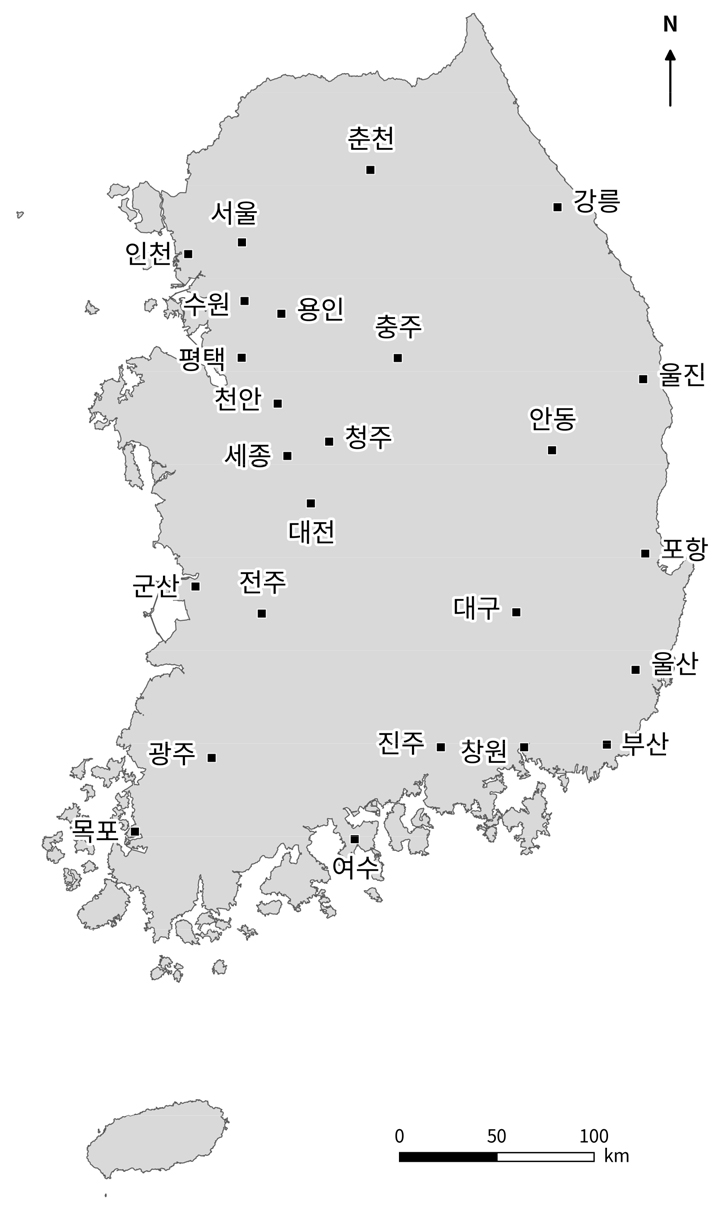
- 인지거리는 물리적 거리와 구별되는 개인의 주관적 공간 인식으로서 사람들의 시공간 행태에 실질적 영향을 미치지만, 도시 간 인지거리에 대한 대규모 실증 연구는 제한적이었다. 이에 본 연구는 대한민국 25개 주요 도시로 구성된 300개 도시쌍을 대상으로 운전면허 보유 성인 2,732명으로부터 도시쌍당 평균 약 180개의 인지거리 응답을 수집하여, 도시 간 인지거리의 공간구조와 결정요인을 분석하였다. 다차원척도법(multidimensional scaling; MDS)을 통해 물리적 공간과 인지적 공간을 비교한 결과, 인지적 공간구조는 남북축은 축소되고 동서축은 확대되어 나타났으며, 응답자들은 도시를 개별적으로 인식하기보다 권역 단위로 군집화하여 인식하는 경향을 보였다. 교차분류다층모형(cross-classified multilevel model; CCMM) 분석 결과, 도시쌍 수준에서는 물리거리와 고속철도 연결이 인지거리에 유의한 영향을 미친 반면 고속도로 연결은 유의하지 않았고, 응답 수준에서는 도시쌍에 대한 경험 패턴(한쪽 거주, 한쪽 방문, 한쪽 거주・한쪽 방문)이, 개인 수준에서는 연간 운행거리가 유의한 영향 요인으로 확인되었다. 반면 연령, 성별, 운전경력, 학력, 소득 등 인구사회학적 특성은 유의한 영향을 미치지 않았다. 본 연구의 결과는 광역교통망 평가와 행정구역・생활권 설정에서 인지거리를 보완적 평가 지표로 활용할 수 있는 근거를 제공한다.
- COLLAPSE
Cognitive distance, the subjective spatial perception that differs from physical distance, exerts a substantive influence on individuals' spatiotemporal behavior; nevertheless, large-scale empirical research on intercity cognitive distance has remained limited. To address this gap, the present study analyzed the spatial structure and determinants of intercity cognitive distance in South Korea, drawing on survey responses from 2,732 licensed adult drivers across 300 city pairs constructed from 25 major cities, with an average of approximately 180 responses per pair. Multidimensional Scaling (MDS) revealed that the cognitive spatial structure was distorted such that the north–south axis was compressed while the east–west axis was expanded, and that respondents tended to perceive cities in regional clusters rather than individually. Cross-Classified Multilevel Model (CCMM) analysis showed that, at the city-pair level, physical distance and high-speed rail (KTX) connectivity had significant effects on cognitive distance whereas direct expressway connection did not, while city-pair experience patterns (residence in one city, visit to one city, and residence in one and visit to the other) at the response level and annual driving distance at the individual level also emerged as significant determinants. By contrast, sociodemographic characteristics such as age, gender, driving experience, education, and income showed no significant effects. These findings provide a basis for using cognitive distance as a complementary evaluation indicator in regional transportation network assessment and in the delineation of administrative districts and daily activity zones.
-
도시 간 인지거리의 공간구조와 결정요인 - 전국 운전자를 대상으로 -
-
Research Article
-
냉전기 한국 지정학의 지식 생산 - 1969년 임덕순과 차윤의 지정학 논쟁 -
The Production of Geopolitical Knowledge in Cold War Korea: The Geopolitics Debate between Im Duck-soon and Cha Yun in 1969
-
이진수
Jinsoo Lee
- 본 연구는 1969년 임덕순과 차윤의 지정학 논쟁을 조사한다. 냉전 중반기, 한국은 중소분쟁의 고착화 및 미국의 동아시아 전략 전환이라는 대외적인 변화에 놓여 있었다. …
This paper examines the geopolitics debate between Lim Duck-soon and Cha Yun in 1969. During the mid-Cold War period, South Korea was …
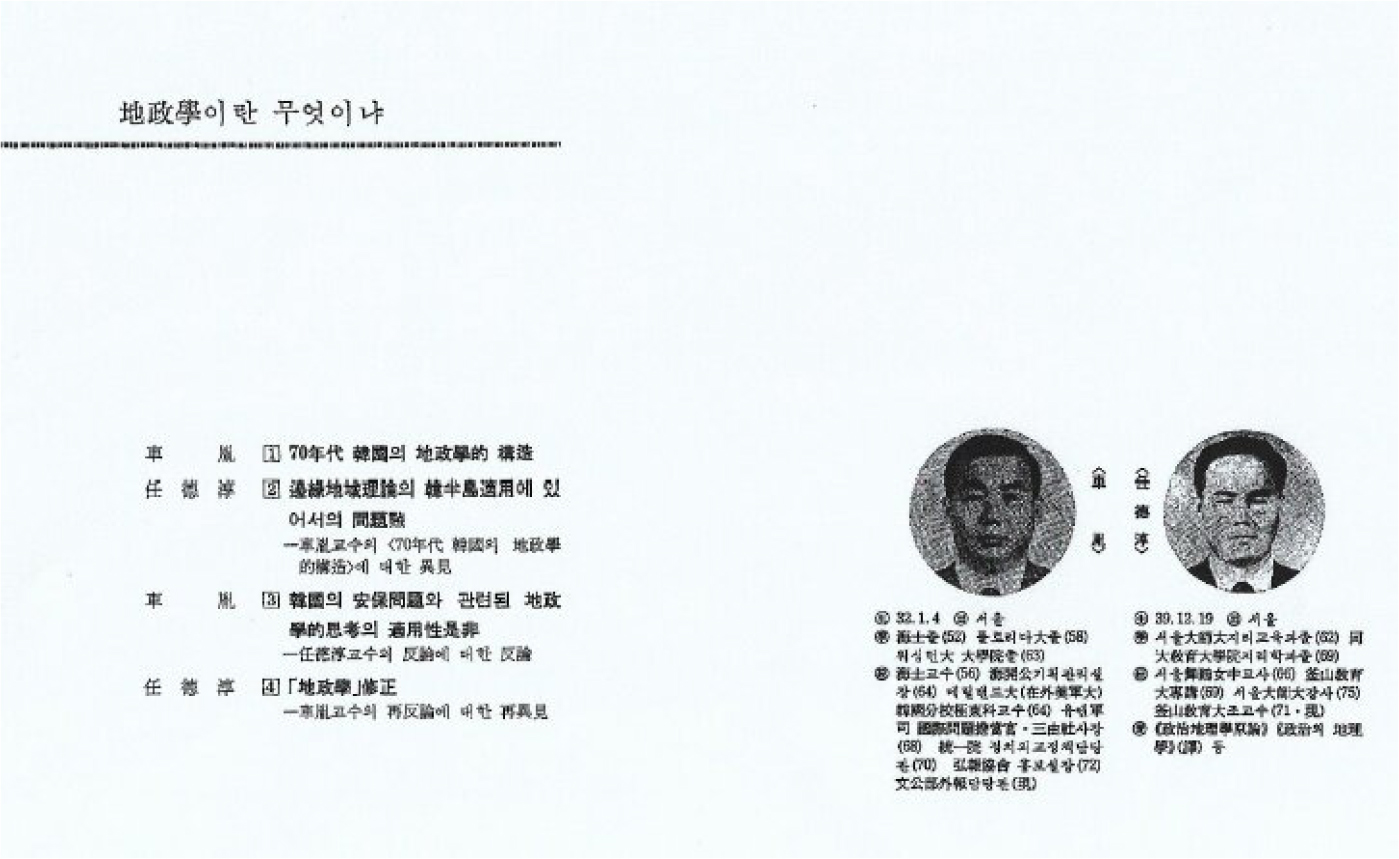
- 본 연구는 1969년 임덕순과 차윤의 지정학 논쟁을 조사한다. 냉전 중반기, 한국은 중소분쟁의 고착화 및 미국의 동아시아 전략 전환이라는 대외적인 변화에 놓여 있었다. 임덕순과 차윤은 한반도의 지리적 위치에 대한 상이한 이해를 바탕으로 국제 정세의 그러한 변화를 해석하고 국가의 생존과 발전에 관하여 논쟁하였다. 본 연구는 이 논쟁을 서구 지정학의 지적 흐름과의 연관 속에서 형성된 한국의 지정학 전통의 일부로 파악하며, 두 학자가 냉전과 분단이라는 역사적 조건 속에서 서구의 지정학적 개념과 반도의 지정학적 상상력을 동원하여 어떻게 자신들의 지정학적 사고를 구성했는가를 분석한다. 본 연구는 한국의 지정학 전통을 서구 지정학의 확산이나 식민적 지식의 내재화로 환원시킬 것이 아니라 다양한 지적 자원이 번역되고 접합되는 지식 생산의 과정으로 이해해야 함을 주장한다. 그럼에도, 이 과정에서 지정학의 제국주의적 기원에 대한 비판적 인식과 이를 냉전과 분단의 현실 속에서 불가피한 지식으로 수용하는 태도가 공존하는 모순이 있었음을 강조한다.
- COLLAPSE
This paper examines the geopolitics debate between Lim Duck-soon and Cha Yun in 1969. During the mid-Cold War period, South Korea was confronted with changes, most notably the consolidation of the Sino-Soviet split and the reorientation of US strategy in East Asia. Based on their contrasting understandings of the Korean Peninsula’s geographical location, Lim and Cha interpreted these changes in the global affairs and debated questions concerning the Korea’s survival and development. This paper regards their debate as the moment of the Korean geopolitical tradition that emerged in relation to broader currents of Western geopolitical traditions, analysing how the two scholars, under the historical conditions of the Cold War and the inter-Korean division, mobilised Western geopolitical concepts alongside geopolitical imaginaries of the peninsula to construct their own geopolitical thoughts. The paper argues that Korean geopolitical tradition should be understood as a process of knowledge production in which diverse intellectual resources were translated and articulated, rather than as a simple diffusion of Western geopolitics or an internalisation of colonial knowledge, but remains cautious that this process embodied a contraversy that a critical awareness of geopolitics’ imperial origins coexisted with a willingness to embrace it as indispensable knowledge under the realities of the Cold War and the inter-Korean division.
-
냉전기 한국 지정학의 지식 생산 - 1969년 임덕순과 차윤의 지정학 논쟁 -
-
Research Article
-
한반도 대기질에 영향을 미치는 PM10 이류의 유효바람방향
Wind Directions for Effective PM10 Advection over the Korean Peninsula
-
백윤지, 강남영
Younji Baek, Namyoung Kang
- 한반도 대기질은 미세먼지(PM10)의 이류 정도에 큰 영향을 받는다. 고농도 미세먼지가 발생하였을 때, PM10 농도 변동에 대한 이류의 설명력은 최대 …
Air quality over the Korean Peninsula is significantly influenced by the advection of particulate matter (PM10). During high-concentration episodes, up …
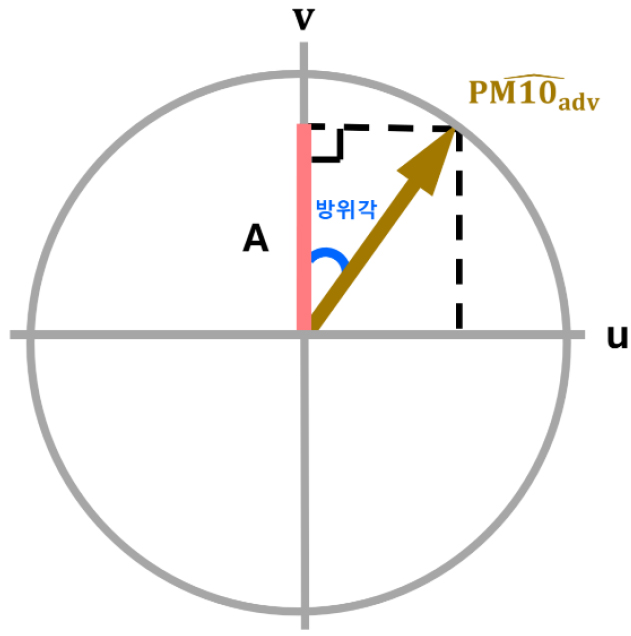
- 한반도 대기질은 미세먼지(PM10)의 이류 정도에 큰 영향을 받는다. 고농도 미세먼지가 발생하였을 때, PM10 농도 변동에 대한 이류의 설명력은 최대 80%까지 나타났다. 본 논문은 한반도 대기질에 영향을 미치는 PM10 이류의 계절별 유효바람방향을 추출하고 그 기압계 패턴을 분석하였다. 이를 위해 에어로졸 재분석 자료를 활용하여 유효바람방향을 모델링하고 이에 대한 지위고도장을 산출하였다. PM10의 이류는 봄, 겨울, 가을 그리고 여름 순으로 크게 나타났다. 한편, 다른 계절과 달리 가을철은 만주지역 토양수분 함량의 감소 특성과 맞물려, 북서풍이 커질수록 PM10의 이류가 잘 드러나는 특징을 보였다. 이는 가을철 서고동저형 기압계가 이르게 형성될 경우, 북서풍을 따라 고농도 PM10이 한반도에 유입될 가능성이 높아짐을 시사한다. 본 연구의 결과는 한반도에서 발생하는 고농도 미세먼지의 계절별 특성과 이를 유발하는 기후학적 배경을 이해하는데 기여할 것으로 기대된다.
- COLLAPSE
Air quality over the Korean Peninsula is significantly influenced by the advection of particulate matter (PM10). During high-concentration episodes, up to 80% of the variability can be explained by advection alone. This study develops a model for the seasonal wind directions governing PM10 advection that affect air quality over the Korean Peninsula and analyzes the associated pressure patterns. To this end, aerosol reanalysis data were used to develop a model for the effective wind directions and derive the corresponding geopotential height fields. PM10 advection was the greatest in spring, followed by winter, fall, and summer. Notably, unlike other seasons, fall showed a distinct characteristic where decreasing soil moisture over the Manchuria region causes stronger northwesterly PM10 advection. This suggests that when a west-high/east-low pressure pattern forms earlier than usual in fall, high-concentration PM10 is likely to increase over the Korean Peninsula by the northwesterly flows. These results indicate the potential utility of the specific pressure patterns and wind directions to suppose the seasonal advection of high PM10 in advance. The findings of this study are expected to contribute to a better understanding of the seasonal characteristics of high PM10 episodes over the Korean Peninsula and the climatological conditions associated with their occurrences.
-
한반도 대기질에 영향을 미치는 PM10 이류의 유효바람방향
-
Research Article
-
소용돌이도 분석을 통한 한반도 영역의 최근 기후환경 진단
Assessment of the Recent Climatic Environment over the Korean Peninsula through Vorticity Analysis
-
강남영, 윤상현
Namyoung Kang, Sanghyeon Yun
- 본 연구는 소용돌이도 분석을 통해 최근 한반도에서 발생하는 극한기상현상의 기후적인 배경을 이해하고자 하였다. 소용돌이도가 유선함수의 공간 이차 미분으로서 기압계의 국지적인 굴곡을 효과적으로 …
This study aimed to understand the climatic environment of recent extreme weather phenomena occurring in the Korean Peninsula through vorticity analysis. Vorticity, …
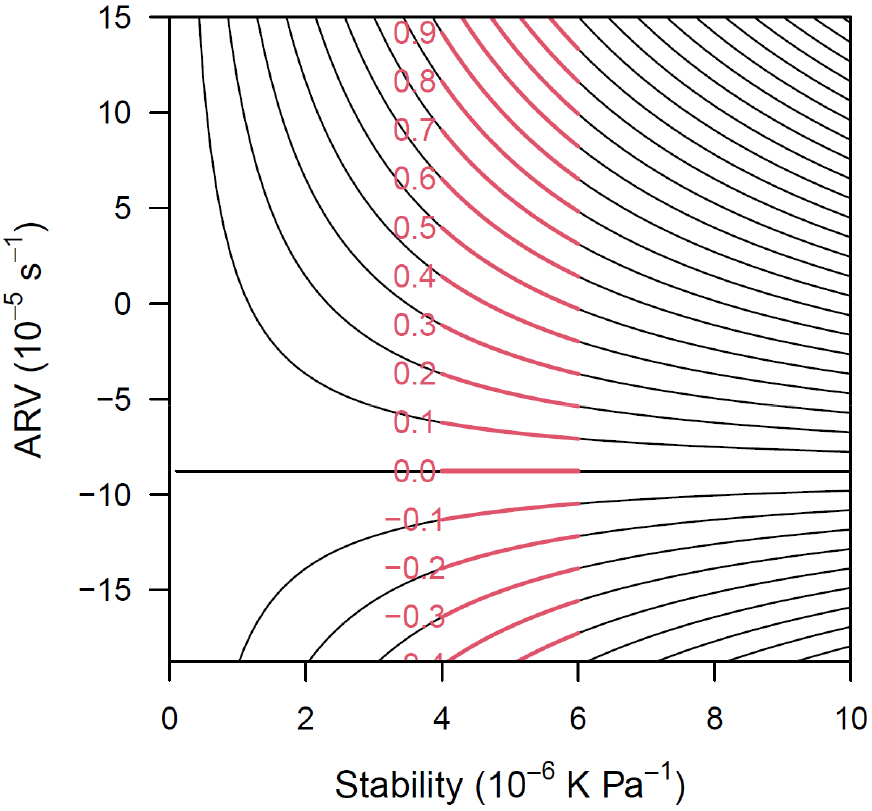
- 본 연구는 소용돌이도 분석을 통해 최근 한반도에서 발생하는 극한기상현상의 기후적인 배경을 이해하고자 하였다. 소용돌이도가 유선함수의 공간 이차 미분으로서 기압계의 국지적인 굴곡을 효과적으로 모사한다는 점에 주목하여, 1991~2020년 평년 기간의 에르텔위치소용돌이도(EPV)와 본 연구에서 새롭게 고안한 가용상대소용돌이도(ARV)를 활용해 한반도의 기후환경을 진단하였다. 분석 결과, EPV의 기후학적 분포와 변화 경향은 백두대간으로 대표되는 한반도의 산지 분포를 뚜렷하게 반영하였다. 특히 실질적인 재해 가능성을 나타내기 위해 ARV에서 상대소용돌이도의 기후값을 제외한 편차의 분포를 분석한 결과, 2020년대의 산불 및 가뭄 발생지는 고기압성 소용돌이도 편차 영역과, 대규모 홍수 발생지는 저기압성 소용돌이도 편차 영역과 지리적으로 부합하는 양상을 보였다. 이는 평년기간의 기후값과 그 기간 내의 변화 경향을 함께 분석한 것으로, 기발생한 재해의 사후 해석을 넘어 향후 나타날 잠재적 재해의 유형과 취약 지역을 특정할 수 있다는 점에서 그 가치가 크다.
- COLLAPSE
This study aimed to understand the climatic environment of recent extreme weather phenomena occurring in the Korean Peninsula through vorticity analysis. Vorticity, which is functionally the second spatial derivative of the stream function, is considered an effective indicator of local variations of pressure patterns. Using Ertel's Potential Vorticity (EPV) over a 30-year climatological period (1991–2020) and the newly devised Available Relative Vorticity (ARV) for practical interpretation, the climatic environment of the Korean Peninsula was examined. The spatial distribution of climatological EPV and its trends during this period revealed clear influences of topography and geography. In particular, analysis of the difference between ARV and the climatological relative vorticity, the distribution of ARV anomalies showed geographical correspondence with recent disaster-affected regions in the 2020s, with wildfire and drought regions aligning with anticyclonic vorticity anomaly areas and major flood regions aligning with cyclonic vorticity anomaly areas. This combined analysis of climatological values and their trends not only explain past events but also provides valuable insights into the types and locations of potential disaster phenomena that may occur in the near future.
-
소용돌이도 분석을 통한 한반도 영역의 최근 기후환경 진단
-
Research Article
-
한국 스마트시티 확장에 대한 시민지지 - 가치 차원, 도시 거버넌스 및 공간 인식 -
Citizens’ Support for Smart City Expansion in South Korea: Value Dimensions, Urban Governance, and Spatial Perceptions
-
조윤정
Yooncheong Cho
- 스마트시티는 기술혁신, 지속가능성, 도시 경쟁력과 연계된 주요 도시발전 전략으로 주목받고 있다. 그러나 시민들이 스마트시티 확장을 어떻게 평가하고 지지하는지에 대해서는 보다 심층적인 이해가 …
Smart cities have emerged as important urban development strategies associated with technological innovation, sustainability, and urban competitiveness. However, opportunities remain to better …
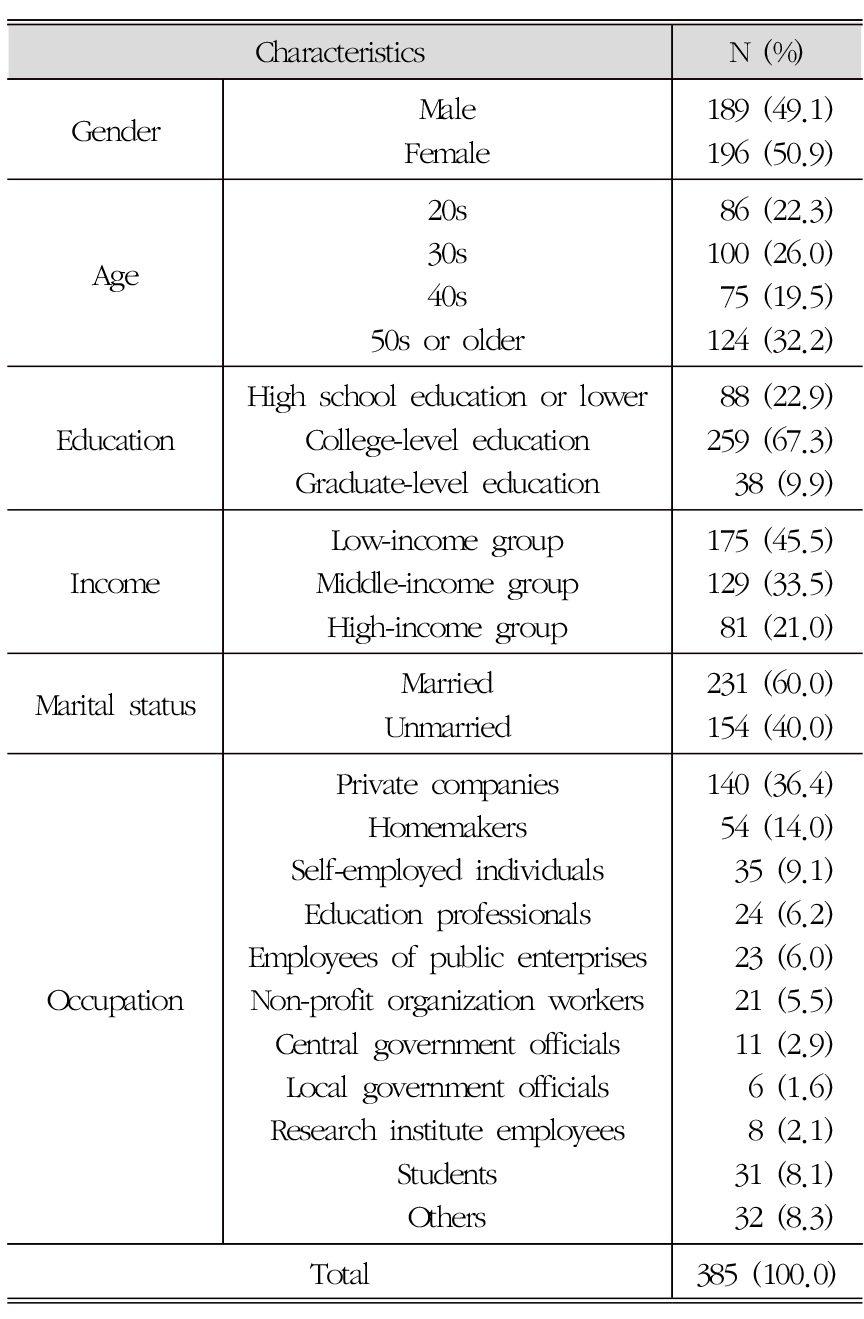
- 스마트시티는 기술혁신, 지속가능성, 도시 경쟁력과 연계된 주요 도시발전 전략으로 주목받고 있다. 그러나 시민들이 스마트시티 확장을 어떻게 평가하고 지지하는지에 대해서는 보다 심층적인 이해가 필요한 상황이다. 본 연구는 인구사회학적 특성, 인식 및 지각 변수, 그리고 보다 광범위한 스마트시티 가치 차원을 중심으로 시민들의 스마트시티 확장 지지에 영향을 미치는 요인을 분석하였다. 이를 위해 한국의 응답자 385명을 대상으로 수집한 온라인 설문조사 자료를 활용하였으며, 탐색적 요인분석과 위계적 순서형 로지스틱 회귀분석을 실시하였다. 탐색적 요인분석 결과, 스마트시티 인식과 관련된 네 가지 잠재 가치 차원인 혁신 및 경제적 가치(Innovation & Economic Value), 삶의 질 및 경험(Quality of Life & Experience), 개방적 거버넌스(Open Governance), 사회·제도적 가치(Social & Institutional Value)가 도출되었다. 분석 결과, 인구사회학적 특성만으로는 스마트시티 확장 지지를 충분히 설명하지 못한 반면, 보다 광범위한 스마트시티 가치 차원은 상대적으로 높은 설명력을 보였다. 또한 스마트시티의 활용성에 대한 인식은 스마트시티 확장 지지에 유의한 정(+)의 영향을 미치는 것으로 나타났다. 특히 혁신 및 경제적 가치가 스마트시티 확장 지지에 가장 강력한 영향요인으로 확인되었으며, 사회·제도적 가치와 개방적 거버넌스도 유의한 영향을 보였다. 연구결과는 스마트시티 확장에 대한 시민들의 지지가 기술혁신이나 경제성장에 대한 기대뿐만 아니라, 이해관계자 참여, 협력적 거버넌스, 제도적 개선, 사회적 신뢰, 그리고 체험적 공공서비스에 대한 인식과도 밀접하게 관련되어 있음을 보여준다. 본 연구는 스마트시티 확장 지지를 보다 폭넓은 사회적·거버넌스적·공간적 관점에서 분석함으로써 스마트시티 및 지리학 연구에 기여한다. 또한 성공적인 스마트시티 발전을 위해서는 기술 발전뿐만 아니라 시민중심의 거버넌스, 제도적 정당성, 그리고 의미 있는 도시 경험이 중요함을 시사한다
- COLLAPSE
Smart cities have emerged as important urban development strategies associated with technological innovation, sustainability, and urban competitiveness. However, opportunities remain to better understand how citizens evaluate and support smart city expansion. This study examines factors influencing citizens’ support for smart city expansion by focusing on demographic characteristics, awareness and perception variables, and broader smart city value dimensions. Using online survey data collected from 385 respondents in South Korea, this study employs exploratory factor analysis and hierarchical ordered logistic regression analyses. The exploratory factor analysis identified four latent value dimensions associated with smart city perceptions: Innovation & Economic Value, Quality of Life & Experience, Open Governance, and Social & Institutional Value. The results indicate that demographic characteristics alone provide limited explanatory power, whereas broader smart city value dimensions exert substantially stronger effects on support for smart city expansion. Among the explanatory variables, Innovation & Economic Value emerged as the strongest predictor, followed by Social & Institutional Value and Open Governance. Perceived utilization of smart cities also showed a significant positive effect on support. The findings suggest that citizens’ support for smart city expansion is shaped not only by expectations regarding technological innovation and economic growth, but also by perceptions related to stakeholder participation, collaborative governance, institutional improvement, social trust, and experiential public services. This study contributes to the smart city and geographic literature by examining citizens’ support for smart city expansion from broader social, governance-related, and spatial perspectives. The findings imply that successful smart city development requires not only technological advancement but also citizen-centered governance, institutional legitimacy, and socially meaningful urban experiences.
-
한국 스마트시티 확장에 대한 시민지지 - 가치 차원, 도시 거버넌스 및 공간 인식 -
-
Research Article
-
한국 대학의 기술지식 창출 네트워크 분석 - 발명자 근접성과 기술 응집성을 중심으로 -
Analyzing Technological Knowledge Creation Networks of Korean Universities: Focusing on Inventor Proximity and Technological Cohesion
-
정희재
Heejae Chung
- 본 논문의 목적은 한국 대학의 기술지식 창출이 공간적으로 전개되는 양상을 살펴보는 것이다. 이를 위하여 대학이 출원에 참여한 특허 자료를 기반으로 물리적 공간과 …
This study investigates the spatial patterns of technological knowledge creation activities by universities in South Korea. Using patent data involving university applicants, …
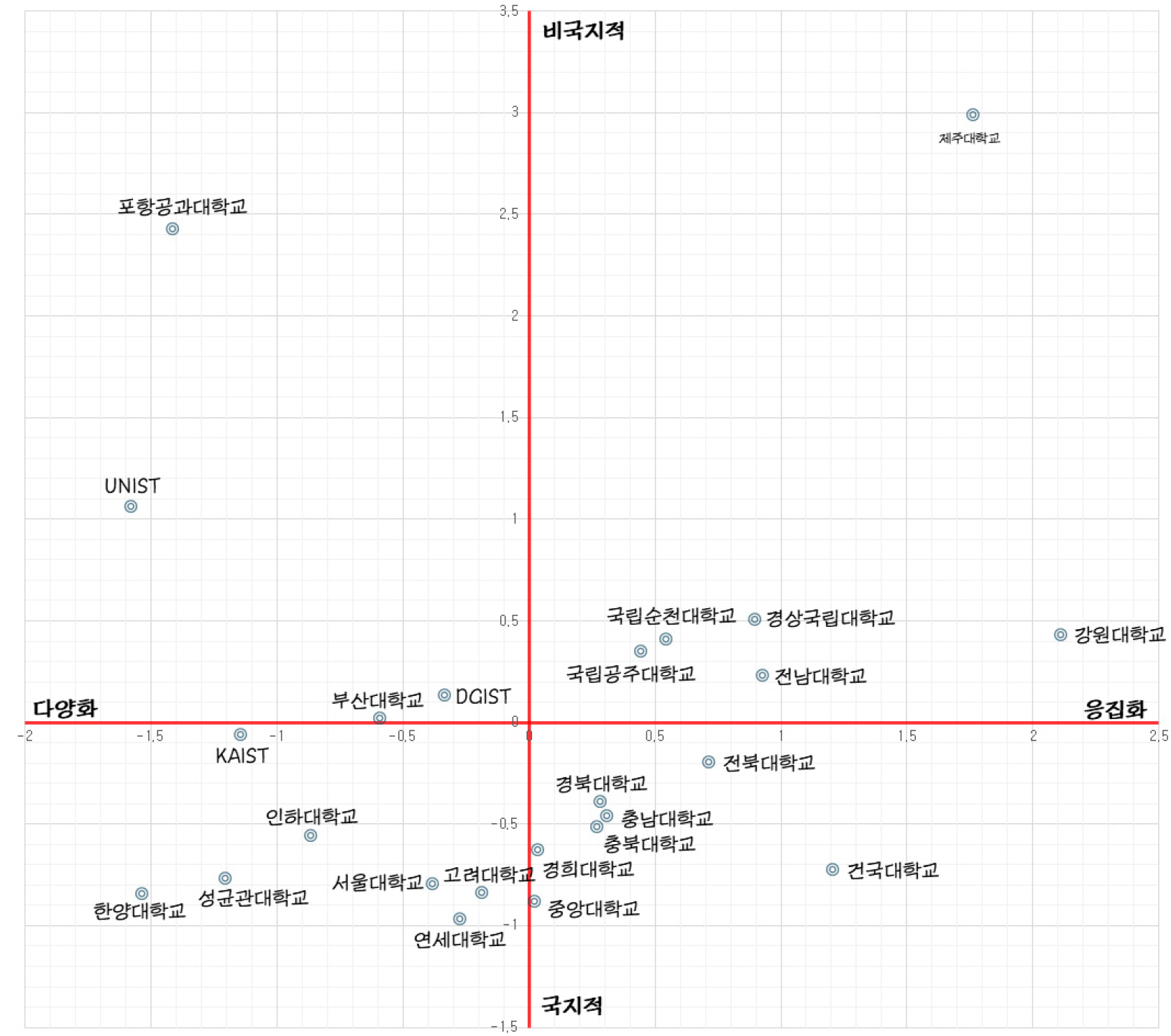
- 본 논문의 목적은 한국 대학의 기술지식 창출이 공간적으로 전개되는 양상을 살펴보는 것이다. 이를 위하여 대학이 출원에 참여한 특허 자료를 기반으로 물리적 공간과 기술적 공간 두 가지 측면에서 네트워크 분석을 수행하였다. 물리적 공간 면에서는 발명자와 대학 간의 거리를 기반으로 대학별 가중평균발명자거리(WAID)를 산출하고 기술적 공간 면에서는 기술 간의 관련성을 바탕으로 대학별 가중평균기술관련성(WAR)을 계산하였다. 그 결과 대학의 기술지식 창출은 일차적으로 지리적 근접성을 기반으로 이루어지는 한편, 비수도권 대학들은 수도권과의 원거리 협력에 일부 의존하고 있는 양상을 확인하였다. 기술 응집성 면에서는 대학별 편차가 크지 않은 것으로 나타났다. 또한, 비수도권 대학들 중에 수도권 연결 비중이 작고 국지적 연계 비중이 높은 유형이 발견되며, 비수도권 내부에서도 대학의 네트워크 형태가 상이하게 형성됨을 확인할 수 있었다. 이러한 결과는 대학을 중심으로 한 지역혁신 정책을 설계할 때, 지역과 산업의 맥락 따라 상이한 연계 관계를 면밀히 고려할 필요가 있음을 시사한다.
- COLLAPSE
This study investigates the spatial patterns of technological knowledge creation activities by universities in South Korea. Using patent data involving university applicants, we examine university knowledge networks from two complementary perspectives, physical space and technological space. In the physical dimension, we calculate the Weighted Average Inventor Distance (WAID) for each university based on the geographical distance between universities and inventors. In the technological dimension, we measure the Weighted Average Relatedness (WAR) using the degree of relatedness among technological fields. The results indicate that university knowledge creation is primarily grounded in geographical proximity, while universities located outside the Seoul metropolitan area rely, to some extent on long-distance collaborations within metropolitan partners. In contrast, technological knowledge creation exhibits relatively limited variation across universities in terms of technological relatedness. Furthermore, among non-metropolitan universities, we identify a distinct group characterized by strong local collaboration and relatively weak connections to the metropolitan area, suggesting that university knowledge networks are heterogeneous even within non-metropolitan regions. These findings highlight that university-centered regional innovation policies should account for the diverse spatial and technological collaboration patters of universities, taking into consideration the specific regional and industrial contexts in which they operate.
-
한국 대학의 기술지식 창출 네트워크 분석 - 발명자 근접성과 기술 응집성을 중심으로 -
-
Research Article
-
인류세의 테크노스피어 형성과 국가 - 한일 댐 건설의 궤적을 중심으로 -
The State in Shaping the Anthropocene Technosphere: Trajectories of Dam Construction in South Korea and Japan
-
김지혜, 장한별, 김선민, 안새롬, 박범순
Jihye Kim, Hanbyeol Jang, Sunmin Kim, Saerom Ahn, Buhm Soon Park
- 테크노스피어는 인프라 및 산업・주거 시설과 이를 통해 조직되는 에너지와 물질, 정보 등으로 구성된 행성적 규모의 물질-기술 시스템으로, 오늘날 인류세는 산업화 및 자본주의와 …
The technosphere is a planetary-scale material-technological system comprising infrastructure, industrial and residential facilities, and the flows of energy, materials, and information organized …
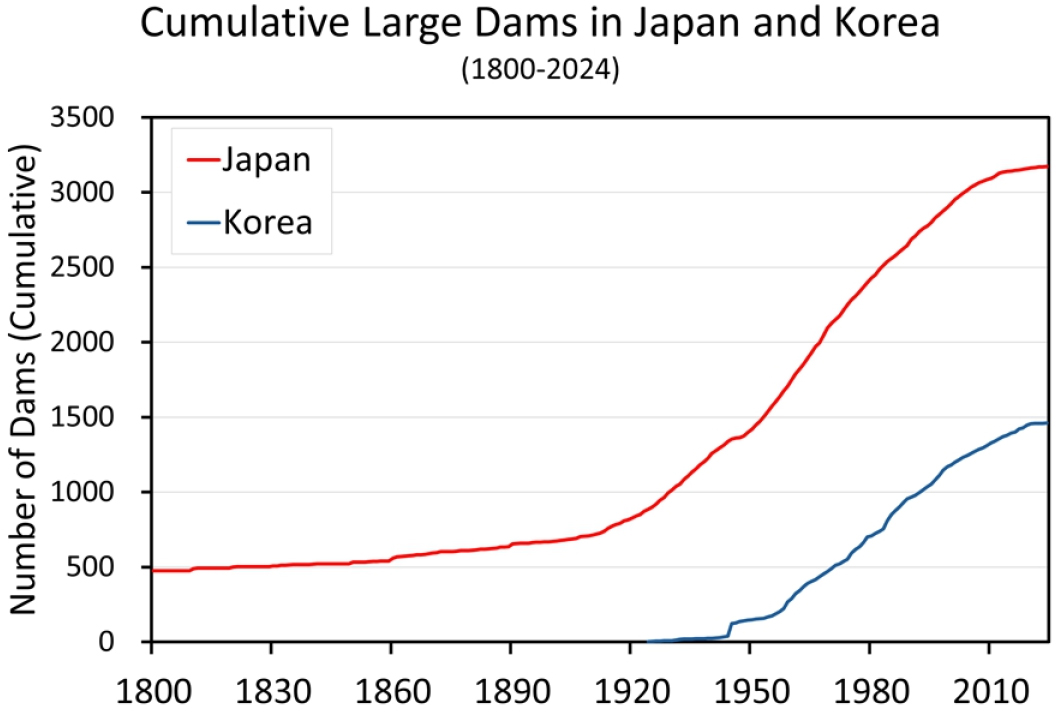
- 테크노스피어는 인프라 및 산업・주거 시설과 이를 통해 조직되는 에너지와 물질, 정보 등으로 구성된 행성적 규모의 물질-기술 시스템으로, 오늘날 인류세는 산업화 및 자본주의와 식민주의 등 서구의 사상과 실천에 의해 테크노스피어가 확산됨으로써 형성되고 있다고 널리 논의되고 있다. 그러나 인류세를 서구의 팽창 결과로만 이해하기에는 부족함이 있다. 인류세가 가시화되는 시기는 비서구, 특히 동아시아 국가가 이른바 ‘근대화’를 경험하는 시기와 겹치기 때문이다. 이 과정에서 동아시아는 서구의 기술과 사상의 수동적 수여자이기보다는 그것과 결합하여 인류세를 형성하는 데에 고유한 역할을 수행하였다. 특히 국가 주도의 인프라 건설과 적극적인 시장 형성은 인류세를 가시화하는 데에 기여하였다. 따라서 본 연구는 동아시아 국가의 행위성에 주목하여 인류세를 재해석할 필요가 있음을 주장하고 이를 예시하는 한 사례로 한국과 일본의 댐 건설 역사를 추적한다. 대형 댐은 인류세 대가속의 주요 지표로 선정되었을 만큼 근대적 지구공학의 상징이자 주요한 테크노스피어 경관이라고 할 수 있다. 이 연구는 두 국가의 사례를 통해서 동아시아의 전통적인 치수(治水) 실천에 제국주의와 식민주의, 전쟁, 냉전, 발전주의와 같은 역사적 조건이 덧대어져 구성된 인류세의 한 단면을 보여준다. 동시에 테크노스피어를 형성하는 국가의 행위성에만 주목하는 것이 아니라, 국가의 의도를 넘어서는 테크노스피어의 통제불가능성에 대해서도 논의함으로써 인류세에 국가의 새로운 역할과 책임이 요청된다는 점을 가시화한다는 점에서 의의가 있다.
- COLLAPSE
The technosphere is a planetary-scale material-technological system comprising infrastructure, industrial and residential facilities, and the flows of energy, materials, and information organized through them. The Anthropocene is widely understood to have emerged through the expansion of the technosphere driven by Western ideas and practices associated with industrialization, capitalism, and colonialism. Yet understanding the Anthropocene solely as an outcome of Western expansion is insufficient. The period in which the Anthropocene became increasingly manifest coincided with the so-called “modernization” of non-Western societies, particularly those in East Asia. Rather than acting merely as passive recipients of Western technologies and ideas, East Asian states combined them with their own institutions and practices, thereby playing a distinctive role in shaping the Anthropocene. State-led infrastructure development and the active creation of markets, in particular, contributed significantly to its material manifestation. This study therefore argues for a reinterpretation of the Anthropocene that takes seriously the agency of East Asian states and illustrates this argument by tracing the histories of dam construction in Korea and Japan. Large dams, identified as one of the major indicators of the Great Acceleration, are both emblematic of modern geoengineering and prominent landscapes of the technosphere. Through a comparative examination of Korea and Japan, this study shows how a particular configuration of the Anthropocene emerged as longstanding East Asian practices of water management (治水) became entangled with historical conditions including imperialism, colonialism, war, the Cold War, and developmentalism. At the same time, the study moves beyond an exclusive focus on state agency in the making of the technosphere by examining how technospheric systems can exceed state intentions and elude control. In doing so, it highlights the need to reconsider the roles and responsibilities of the state in the Anthropocene.
-
인류세의 테크노스피어 형성과 국가 - 한일 댐 건설의 궤적을 중심으로 -
-
Research Article
-
장대단층 중부 모곡리 지점 단층의 최후기 운동 시기와 지진 규모 추정
The Timing of the Most Recent Fault Movement and Estimated Seismic Magnitude of the Mogok-ri Site in the Central Part of the Jangdae Fault
-
홍영민, 최정헌, 신재열
Yeong-Min Hong, Jeong-Heon Choi, Jae-Ryul Shin
- 장대단층 중부 구간에 위치한 모곡리 지점은 미고결 퇴적층의 변위를 통해 제4기 활동 가능성이 제기되었으나, 퇴적층의 수치 연대에 기반한 최후기 운동 시기와 추정 …
The Mogok-ri site, located in the central part of the Jangdae Fault, is considered to have been reactivated during the Quaternary, displacing …
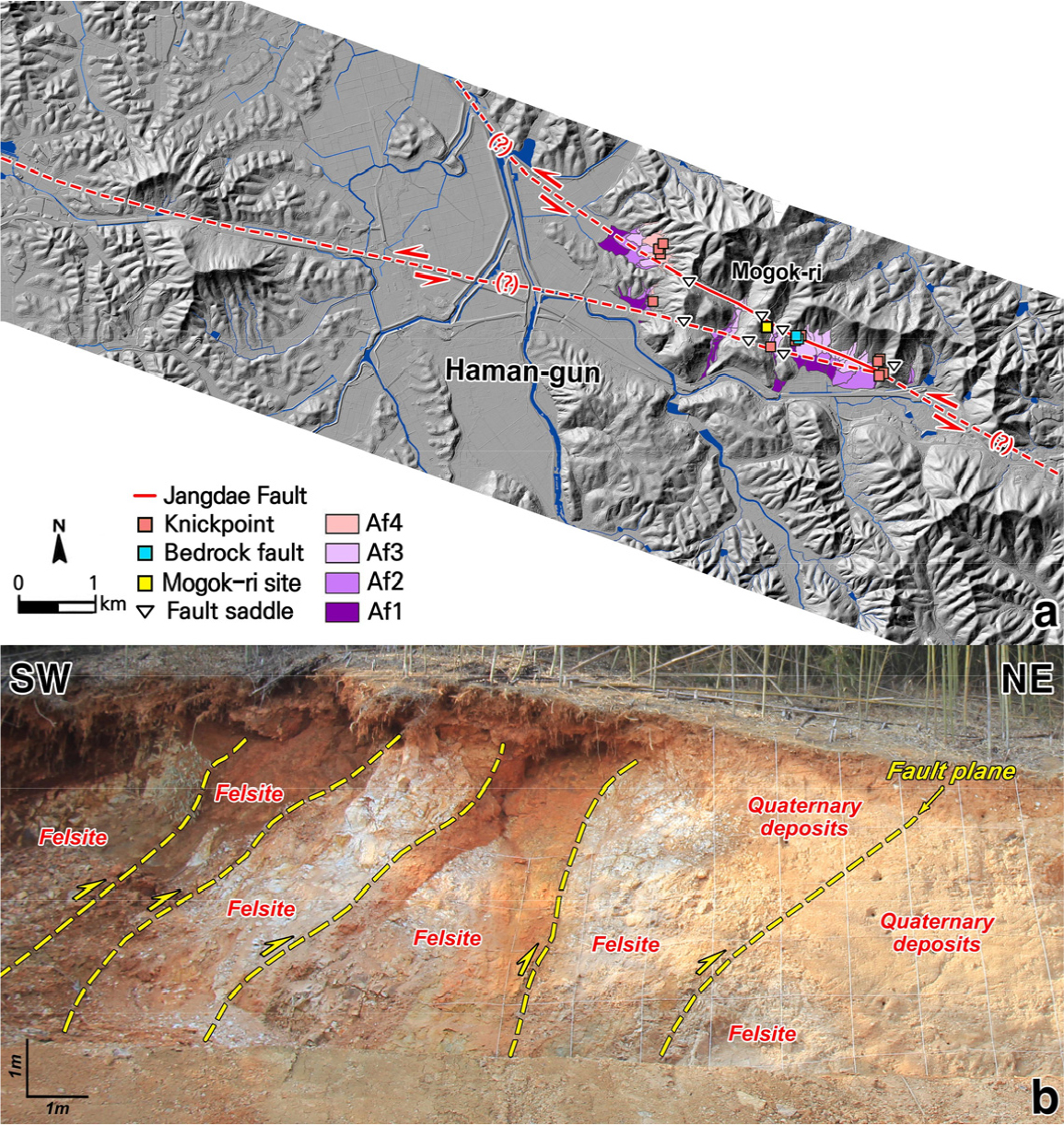
- 장대단층 중부 구간에 위치한 모곡리 지점은 미고결 퇴적층의 변위를 통해 제4기 활동 가능성이 제기되었으나, 퇴적층의 수치 연대에 기반한 최후기 운동 시기와 추정 지진 규모가 논의되지 못하였다. 이 연구에서는 모곡리 지점의 미고결 퇴적층을 대상으로 루미네선스 연대 측정을 수행하고 노두에서 산정된 변위에 근거하여 모멘트 규모(Mw)를 추정하였다. 루미네선스 연대 측정 결과, 단층에 의해 절단된 퇴적층과 단층을 피복하고 있는 퇴적층의 연대를 고려하면, 모곡리 지점 단층의 최후기 운동 시기는 약 212~178ka로 판단된다. 순수 역이동성 경사 이동을 가정한 모곡리 지점의 실제 변위는 약 0.8m로 산정되며, 이를 경험식에 적용한 결과 모멘트 규모는 약 6.5로 추정된다. 장대단층은 인구가 밀집한 도시 지역 및 주요 산업 시설과 인접해 있고, 이번 연구 결과 장대단층 중부 구간에 위치한 모곡리 지점에서 제4기 동안 단층 운동으로 인해 약 6.5 모멘트 규모의 지진이 동반되었을 가능성이 있다. 따라서, 지진 재해 평가 측면에서 모곡리 지점에 대한 지속적 연구와 추가적인 단층 노두 조사, 지형 변위 분석, 변위율 산정 등이 수행되어야 할 필요가 있다.
- COLLAPSE
The Mogok-ri site, located in the central part of the Jangdae Fault, is considered to have been reactivated during the Quaternary, displacing unconsolidated deposits. However, the numerical dating to understand the timing of most recent fault movement and the estimation of the seismic magnitude have not been performed. In this study, luminescence dating was carried out on the unconsolidated deposits exposed at the Mogok-ri site, and the moment magnitude was estimated based on the displacement measured from the outcrop. The luminescence dating results indicate that, considering the ages of the sediments cut by and overlying the fault, the timing of the most recent fault movement of the Mogok-ri site is constrained to be ca. 212~178ka. Assuming pure reverse dip-slip movement the maximum displacement of the Mogok-ri site is estimated to be approximately 0.8m. Applying this value to the empirical relationship yields an estimated moment magnitude of approximately Mw 6.5. The Jangdae Fault is located near densely populated areas and industrial facilities. The results of this study suggest that the Mogok-ri site, located in the central part of the Jangdae Fault, may have been associated with an earthquake of approximately Mw 6.5 during the Quaternary. Therefore, continued investigations of the Mogok-ri site are necessary from the perspective of seismic hazard assessment, including additional fault outcrop surveys, geomorphic offset analysis, and slip-rate estimation.
-
장대단층 중부 모곡리 지점 단층의 최후기 운동 시기와 지진 규모 추정
-
Research Article
-
다지역 인구이동 추계를 위한 도착지 인구가중 모형의 비교 연구 - CT-DPW 모형의 제안 -
A Comparative Study of Destination Population-Weighted Models for Multiregional Migration Projection: Introducing the CT-DPW Model
-
이상일, 조대헌
Sang-Il Lee, Daeheon Cho
- 본 연구는 다지역 인구이동 추계에서 지역별 인구분포의 변화를 전이확률에 반영하는 도착지 인구가중(destination population-weighted, DPW) 모형군을 비교하고, 새로운 CT-DPW(controlled-total destination population-weighted) 모형을 제안한다. …
This study compares destination population-weighted (DPW) models that incorporate changing regional population distributions into transition probabilities for multiregional migration projection and proposes …
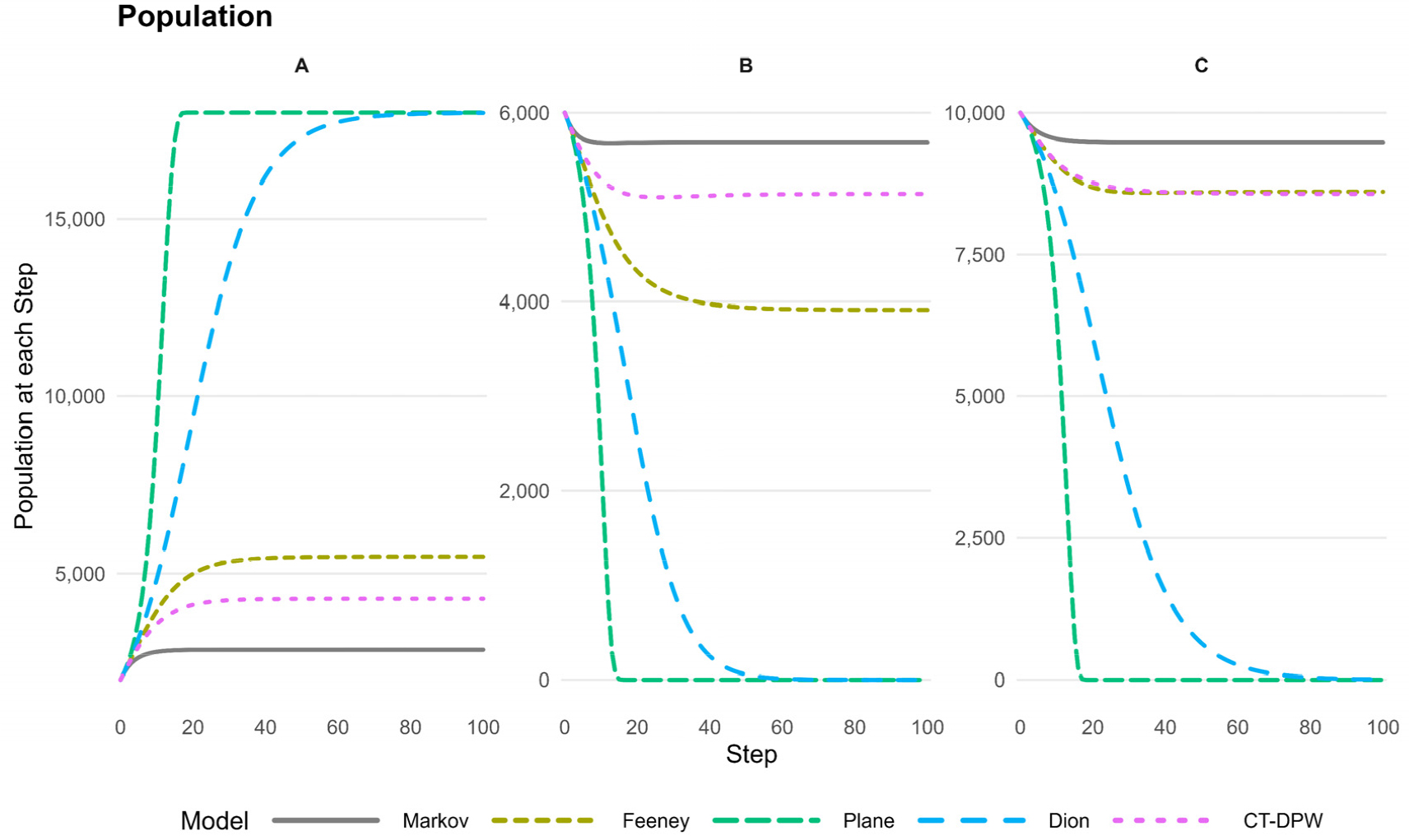
- 본 연구는 다지역 인구이동 추계에서 지역별 인구분포의 변화를 전이확률에 반영하는 도착지 인구가중(destination population-weighted, DPW) 모형군을 비교하고, 새로운 CT-DPW(controlled-total destination population-weighted) 모형을 제안한다. 피니, 플레인 및 디옹 모형은 각 추계 라운드에서 산출된 도착지 인구를 이용하여 전이확률을 갱신하지만, 총전이확률을 처리하는 방식과 인구분포-이동 간 되먹임의 강도에서 차이를 보인다. CT-DPW 모형은 출발지별 총전이확률을 통제하고, 그 총량을 변화한 도착지 인구분포에 따라 목적지별로 재배분한다. 따라서 “얼마나 이동하는가”와 “어디로 이동하는가”를 분리하여 모형화할 수 있다. 세 지역으로 구성된 가상 인구체계를 이용하여 고정 전이확률 모형과 네 가지 DPW 모형을 비교하고, 지역별 인구, 순이동량, 순이동률, 인구이동 유효도 지수 및 총전이확률의 장기적 변화를 분석하였다. 시뮬레이션 결과, 플레인 모형은 강한 되먹임으로 급격한 인구집중을 초래하였고, 디옹 모형은 집중 속도를 완화하였지만 장기적 집중을 방지하지는 못하였다. 피니 모형은 비교적 안정적인 결과를 산출하였으나 총전이확률을 명시적으로 통제하지 않는다. 반면 본 시뮬레이션에서 CT-DPW 모형은 도착지 인구변화에 반응하면서도 총전이확률과 이동지표의 극단화를 억제하여 안정적인 다지역 인구분포를 산출하였다. CT-DPW 모형은 전체 이동성과 도착지별 배분을 분리한다는 점에서 가정의 해석과 시나리오 설정이 용이하며, 향후 총전이확률의 변화경로와 결합된 하이브리드 인구이동 추계 모형으로 확장될 수 있다.
- COLLAPSE
This study compares destination population-weighted (DPW) models that incorporate changing regional population distributions into transition probabilities for multiregional migration projection and proposes a new controlled-total destination population-weighted (CT-DPW) model. The Feeney, Plane, and Dion models update transition probabilities using destination populations generated in each projection round, but differ in their treatment of total transition probabilities and the strength of population-migration feedback. The CT-DPW model controls the total transition probability for each origin and reallocates that total across destinations according to changes in destination populations. It thus separates the modeling of “how much migration occurs” from “where migrants move.” A deterministic simulation based on a hypothetical three-region system compares a fixed transition probability model with four DPW models and examines long-term changes in regional populations, net migration, net migration rates, the migration effectiveness index, and total transition probabilities. The Plane model produces rapid population concentration through strong feedback, whereas the Dion model slows but does not prevent long-term concentration. The Feeney model yields a relatively stable distribution but does not explicitly constrain total transition probabilities. Under the simulation conditions, the CT-DPW model responds to changes in destination populations while limiting the endogenous amplification of total mobility and the divergence of migration indicators, thereby yielding a stable multiregional population distribution. By separating overall mobility from destination allocation, the CT-DPW model improves interpretability and facilitates scenario specification. It can also be extended into a hybrid framework in which future paths of origin-specific total transition probabilities are set and then allocated across destinations through recursive population weighting.
-
다지역 인구이동 추계를 위한 도착지 인구가중 모형의 비교 연구 - CT-DPW 모형의 제안 -
-
Research Article
-
일본 나가노현(長野県) 이나다니(伊那谷) 복합선상지의 수문학적 취약성과 기술적 대응 - 니시텐류 간선수로(西天竜幹線水路)와 원통분수공군(円筒分水工群)을 대상으로 -
Hydrological Vulnerability and Engineering Responses on the Composite Alluvial Fans of the Ina Valley, Nagano Prefecture, Japan: A Case Study of the Nishitenryu Main Irrigation Canal and Cylindrical Division Works
-
탁한명, 양자연
Han-Myeong Tak, Ja-Yeon Yang
- 본 연구는 일본 나가노현 이나다니 류사이(竜西) 지역의 복합선상지와 하안단구를 대상으로, 농업용수 부족의 지형적 요인과 그 극복 과정을 지리학적 지형학의 관점에서 분석하였다. 용수 …
This study analyses the composite alluvial fans and river terraces of the Ryusai area, Ina Valley, Nagano Prefecture, Japan, from the perspective …
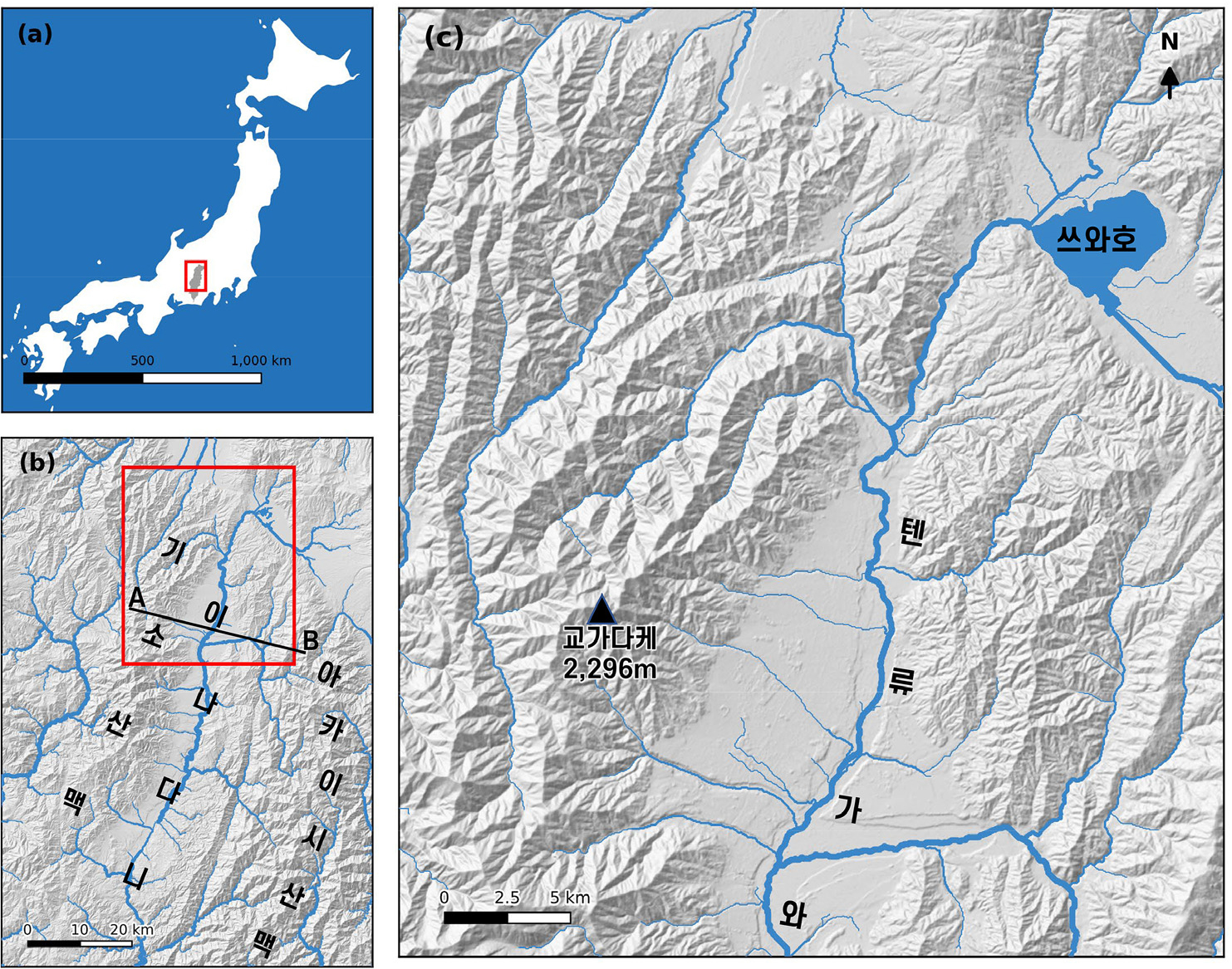
- 본 연구는 일본 나가노현 이나다니 류사이(竜西) 지역의 복합선상지와 하안단구를 대상으로, 농업용수 부족의 지형적 요인과 그 극복 과정을 지리학적 지형학의 관점에서 분석하였다. 용수 부족은 조립질 퇴적층에 의한 복류, 단구면과 하상 간 수십 m의 비고, 함양역 소유역의 규모 한계에서 비롯되었으며, 수량, 취수지 고도, 수리권 조건을 충족하는 쓰와호 유출수가 수원으로 선택되었다. 연장 26km, 평균 구배 0.046%의 니시텐류 간선수로는 등고선을 따라 부설되어 분수공의 선상 배열을 규정하였고, 관행적 분수 질서가 없는 신규 개답지의 물 분쟁은 면적 비례 배분을 구조화한 원통분수공의 일괄적 설치를 통해 일본 유일의 군집형 분수공 경관을 성립시켰다. 이 사례는 지형이 수리적 과제를, 기술적 대응이 경관을 규정하는 공진화 과정을 보여준다.
- COLLAPSE
This study analyses the composite alluvial fans and river terraces of the Ryusai area, Ina Valley, Nagano Prefecture, Japan, from the perspective of geographical geomorphology, combining multilingual documentary cross-verification, DEM analysis, and two field surveys. Chronic irrigation shortage arose from three superimposed landform conditions: subsurface flow through coarse, permeable fan deposits; a relative height of several tens of metres between the fault-uplifted terrace surfaces and the Tenryu riverbed; and the limited size of steep headwater catchments in the Kiso Mountains. Outflow from Lake Suwa was therefore chosen as the source, since it alone satisfied supply stability, intake elevation, and minimal conflict with customary water rights. The 26 km Nishitenryu Main Irrigation Canal (1922-1928), with a gradient of 0.046%, followed the contour of the upper terrace margin and crossed tagiri gorges by tunnels, aqueducts, and inverted siphons. This contour-following route produced a comb-shaped supply system that determined the linear arrangement of the division works, while disputes throughout the newly reclaimed paddies prompted the repeated installation of cylindrical division works, which fix area-proportional shares in built form. The result is Japan's largest and only linearly clustered group of such works—a concentrated case of co-evolution between landform, hydraulic technology, and agricultural landscape.
-
일본 나가노현(長野県) 이나다니(伊那谷) 복합선상지의 수문학적 취약성과 기술적 대응 - 니시텐류 간선수로(西天竜幹線水路)와 원통분수공군(円筒分水工群)을 대상으로 -
-
Research Article
-
한국 대학 특허 기반 기술이전의 공간구조 - 특허 양도와 전용실시권을 중심으로 -
The Spatial Structure of University Patent-Based Technology Transfer in Korea: Evidence from Patent Assignments and Exclusive Licenses
-
채윤식, 박종헌
Yoonsik Chae, Jongheon Park
- 본 연구는 2001년부터 2020년까지 한국 대학에서 국내 민간기업으로 이전된 등록특허를 대상으로, 특허 양도와 전용실시권을 구분하여 대학 특허 기반 기술이전의 공간구조를 분석하였다. 분석 …
This study analyzes the spatial structure of university patent-based technology transfer in Korea, distinguishing patent assignments from exclusive licenses of registered patents …
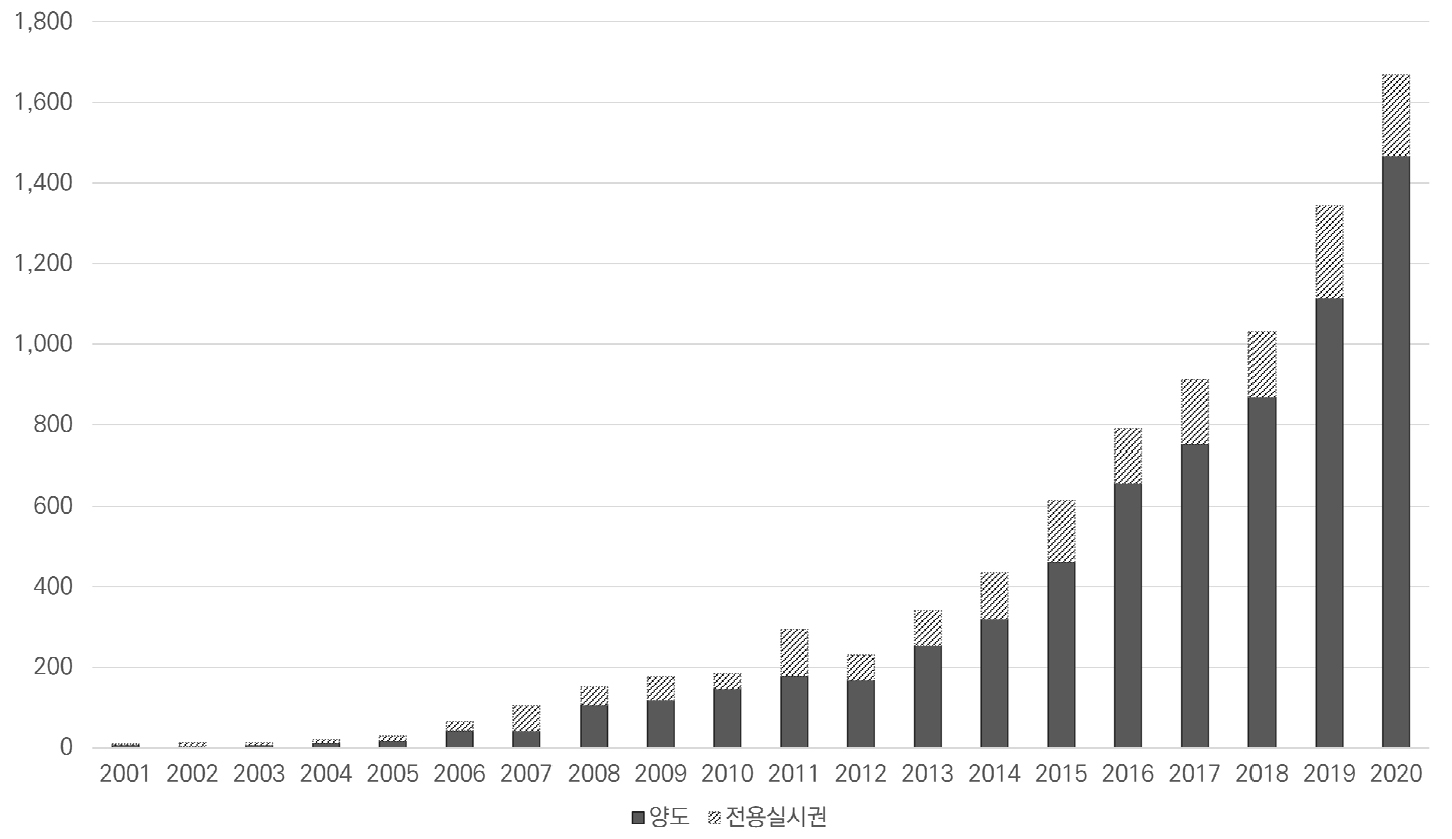
- 본 연구는 2001년부터 2020년까지 한국 대학에서 국내 민간기업으로 이전된 등록특허를 대상으로, 특허 양도와 전용실시권을 구분하여 대학 특허 기반 기술이전의 공간구조를 분석하였다. 분석 결과, 대학 특허 기술이전은 2000년대 후반 이후 증가하기 시작하여 2010년대 중반 이후 빠르게 확대되었다. 공간적으로는 서울, 대전 등 대학・연구 거점이 주요 공급지역으로, 서울과 경기 등 수도권 지역이 주요 수요지역으로 나타났다. 지역 간 연결구조는 수도권 기업수요로 향하는 광역적 이전과 비수도권 광역대도시와 인접지역 간 연결이 동시에 나타났다. 중력모형 분석 결과, 기술분야와 연도별 지역 공급 및 수요 규모를 통제한 이후에도 거리와 행정경계는 기술이전 흐름과 뚜렷한 관련성을 보였으며, 비수도권 대학에서 수도권 기업으로 향하는 기술이전의 흐름도 유의하게 나타났다. 이는 대학 특허 기술이전이 대학 소재지역 내부의 파급효과만으로 설명되지 않으며, 수도권 중심의 공간적 계층성과 권역 내부 연결이 결합된 구조 속에서 형성됨을 보여준다.
- COLLAPSE
This study analyzes the spatial structure of university patent-based technology transfer in Korea, distinguishing patent assignments from exclusive licenses of registered patents transferred from Korean universities to domestic private firms between 2001 and 2020. The results show that university patent-based technology transfer began to increase in the late 2000s and expanded rapidly after the mid-2010s, and that this growth was driven mainly by patent assignments. Spatially, Seoul and Daejeon emerged as major supply regions, while Seoul and Gyeonggi functioned as major demand regions. Interregional linkages were centered on transfers toward firm demand in the Seoul metropolitan area, complemented by intra-regional linkages between non-metropolitan regional cities and neighboring areas. Gravity model estimates show that distance and administrative boundaries were significantly associated with technology transfer flows even after controlling for supply and demand volumes by region, year, and technology field, and that flows from non-metropolitan universities to firms in the Seoul metropolitan area were significantly larger. These findings suggest that university patent-based technology transfer cannot be explained solely by localized spillovers around universities, but is formed within a structure that combines a Capital Region–centered spatial hierarchy with intra-regional linkages.
-
한국 대학 특허 기반 기술이전의 공간구조 - 특허 양도와 전용실시권을 중심으로 -

Journal Informaiton
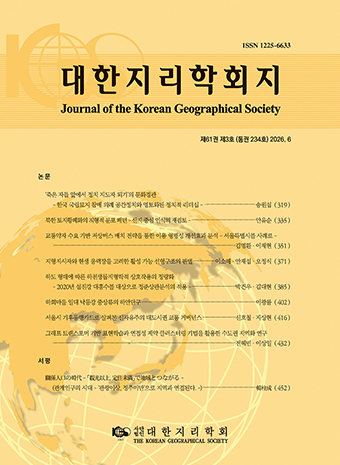 Journal of the Korean Geographical Society
Journal of the Korean Geographical Society







 The Korean Geographical Society
대한지리학회
#1413, 213-12, Saechang-ro, Yongsan-gu, Seoul, Republic of Korea
Tel: 02-875-1463 / Fax: 02-876-2853 / E-mail: geography77@hanmail.net Copyright© The Korean Geographical Society. Powered by APUB
Tel: 02-875-1463 / Fax: 02-876-2853 / E-mail: geography77@hanmail.net Copyright© The Korean Geographical Society. Powered by APUB