


1. Introduction
2. Disaster Resilience
1) Disaster Management and Disaster Resilience
2) Relationship between Disaster Resilience and Smart Disaster Management
3. Overseas Cases studies on Disaster Resilience
4. Analysis of Disaster Management and Smart Disaster Management in Jeju Island
1) Geographical Analysis in Jeju Island
2) Analysis of the disaster status of Jeju Island
3) Analysis of Disaster Management System
4) Analysis of Smart Disaster Management and Safety-Related Projects Status
5. A Study on the Strengthening of Smart Disaster Management System Using Disaster Resilience
1) Advancement of Disaster Management System
2) Smart Disaster Management Using Smart Technology
3) Strengthening and Linking the Capacity of Local Communities and Citizens
6. Conclusions
1. Introduction
A city is activated as the urban population increases, and various functions such as social, economic, political and cultural are developed and grown in the city. Urbanization is positive in terms of creating a diverse and dynamic urban environment such as concentration of infrastructure and industrial development, but behind the scenes, it also causes urban problems such as increased crime rate, shortage of various infrastructure and resources, and environmental pollution. In addition to these problems, the climate change phenomenon affects the size and complexity of disasters, and it is predicted that the more severe the impact, the greater the scale of disaster damage. This is leading to a demand from citizens to establish a disaster management system in a more active way, such as improving the safety system and safety service level in the city. Accordingly, there are increasing attempts to approach disaster management in terms of disaster resilience, which places importance on the ability to respond and adapt appropriately in a disaster situation. There is also an attempt to build a more effective disaster management system by adding the concept of smart disaster management of a smart city.
The purpose of this study is to strengthen the capacity of local communities by accounting local participation in the process of disaster management to minimize urban safety problems caused by large-scale, complex, and unpredictable disasters and urbanization. Accordingly, the concepts of disaster management, disaster resilience, and smart disaster management are summarized to establish concepts to be used in research. In addition, the purpose of this study is to analyze overseas disaster resilience components, indicators, and cases, set the contents and directions of the components, and apply them to propose a plan to strengthen disaster resilience for smart disaster management.
In order to re-establish the concept of disaster resilience and to derive the components and corresponding contents of disaster resilience, literature studies and overseas case studies were conducted. In the process of achieving the purpose of the study, each community has different capabilities and characteristics, so in order to effectively achieve the objective, a target site was selected and analyzed, and reinforcement measures suitable for each region were suggested. For the site analysis method, statistical data and literature were used, and through this, the implications and problems of disaster and disaster management at the site were derived. Finally, by synthesizing the theoretical considerations and analysis results, a plan to strengthen the smart disaster management system applying disaster resilience was sought.
2. Disaster Resilience
1) Disaster Management and Disaster Resilience
Disasters are ‘things that can damage or cause damage to people’s lives, bodies, property, and the nation’, include natural disasters, social disasters, and overseas disasters, and include the 「Basic Act on Disaster and Safety Management」 (hereinafter referred to as the ‘Disaster Safety Act’) is stipulated in Article 3 (1). Disaster management refers to ‘total activities to cope with disasters through the four stages of disaster prevention, preparedness, response, and recovery’.
Resilience is derived from the Latin ‘resílĭo’, which means ‘to jump back’ or ‘to rebound’, and generally means ‘the ability to return to the previous state’. Academically, resilience is a concept that has been advocated and discussed by ecologist Holling (1973) in the 1970s (Kang et al., 2013:9). In addition to this, the concept has been expanded by continuing discussions in various fields such as psychology, engineering, and geography. Resilience in the field of disasters is being interpreted in various ways in the fields of ecology, society, physics, et cetera, and in the range of countries, cities, communities, and individuals. Timmerman (1981), who first introduced the concept of resilience in the field of disasters, defined it as ‘the ability to absorb and recover damage in the event of a disaster’, and the Multidisciplinary Center for Earthquake Engineering Research(MCEER) defined resilience as the ability of social units(meaning organizations, communities) to carry out recovery activities in a way that minimizes confusion and reduces the impact of future disasters (Tierney and Bruneau, 2007: 15). In addition, Godschalk (2003), and Campanella (2006), have defined disaster resilience, and the keywords used in each definition are summarized in Table 1. Comprehensively, the definition of disaster resilience is summarized by focusing on the ‘successful response/adaptation capability of competent units in disaster situations such as danger, disability, and adversity’.
Table 1.
Deriving Prior Research Keywords
In disaster resilience, it is also necessary to consider the components. Campanella (2006) viewed the components of resilience as citizen, planning, redundant capacity, and robust & diversified economy. Economic capability, establishment of an emergency disaster management plan, utilization of extra resources, and shelter are important, but above all else, he emphasized that the capacity of citizens to operate the established disaster management system is important. On the other hand, MCEER presented resilience as four components (R4): Rapidity, Redundancy, Resourcefulness, and Robustness. Most of the components of disaster resilience have been seeking ways to strengthen resilience by using the existing concept of R4 and adding elements such as adaptiveness, community competence, and flexibility.
Rapidity refers to the ability to respond to minimize loss of systemic functions, to prevent the interruption of functions, and to recover and replace them again. Resourcefulness is the ability to diagnose and rank crisis phenomena and their problems and solve them by mobilizing resources such as technical, material, and human resources. It refers to the ability of a robust system to withstand well (Tierney and Bruneau, 2007). Community Competence refers to the ability of community members to form relationships among community members through an understanding of local risks, and to make decisions and respond in crisis situations based on this. A citizen is defined as an individual with the capacity to properly manage institutional, material, and financial resources when the above five components are well established in the local community.
2) Relationship between Disaster Resilience and Smart Disaster Management
In this study, the term resilience is used as is without translation, and for the convenience of notation, it is written as 'resilience'. Based on theoretical considerations, disaster resilience is used in the meaning of ‘the ability of social units to change and respond to the effects of risk in order to maintain the functioning and structure of society in times of crisis or disaster’. The social units in this definition refer to individuals, communities, and infrastructure. In the components of resilience, the city’s legal system (software) as well as the physical environment (hardware) are important, but the ability of individuals or communities to harmoniously operate these components (humanware) is likewise significant. Accordingly, the concept and components of disaster resilience were constructed by adding Community Competence and Citizen to Rapidity, Redundancy, Resourcefulness, and Robustness. If a systematic resilience system of the local community is established based on the six components, it is believed that it viably responds flexibly to social risks and disaster situations and ultimately strengthen the disaster resilience.
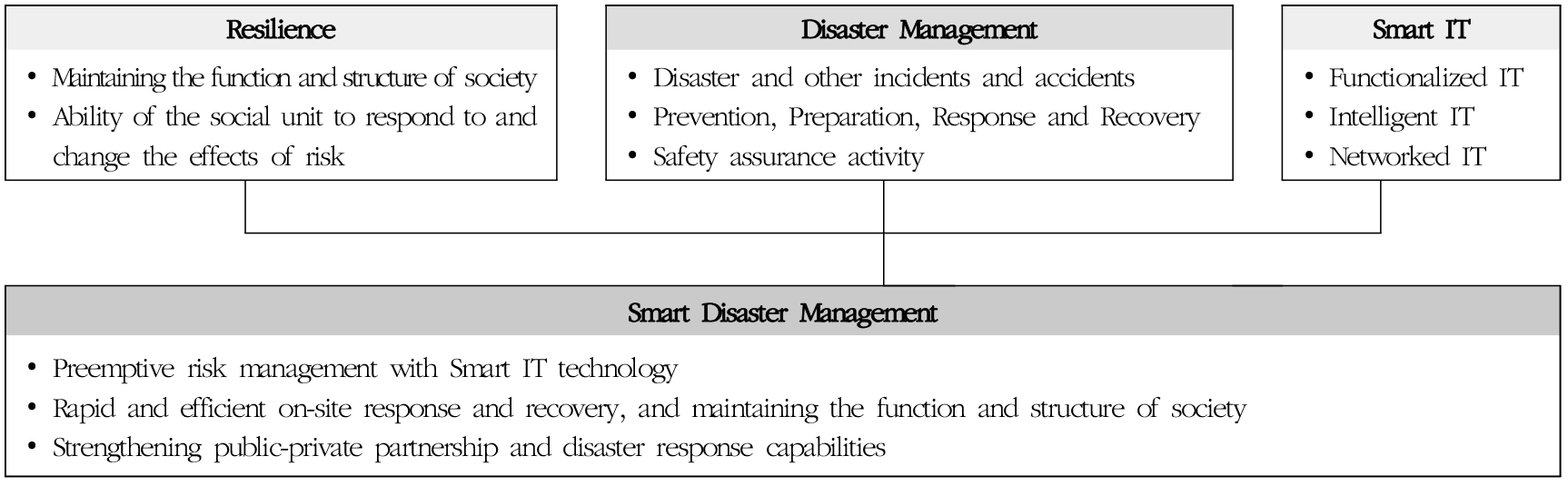
The recent international joint effort ‘Sendai Framework1)’ utilizes resilience for effective disaster response. The Sendai Framework emphasizes the preparation of disaster countermeasures through the climate change response environment, development for the purpose of alleviating poverty, and disaster risk reduction through disaster management. Based on this background, in order to effectively respond to disasters and to utilize the concept of disaster resilience more effectively, it is necessary to apply it and build a disaster management system. Therefore, discussions were conducted in consideration of smart disaster management. Smart disaster management is a combination of a disaster management system and smart IT technology2), and it means building a more effective disaster management system in a smart city that efficiently manages and solves urban problems using ICT technology (Fig. 1). These disaster management strategies are centered on smart governance, smart prevention and preparedness, and smart on-site response.
3. Overseas Cases studies on Disaster Resilience
Case studies of London, UNDRR, and Arup & Rockefeller Foundation were conducted to examine how disaster resilience is applied and utilized abroad. ‘The London Resilience Partnership’ in London was prepared to prepare for large-scale emergencies that may occur in the future (Han et al., 2015). It was approved at the London Resilience Forum in 2013 and is currently implementing the third strategy. The concept of resilience is defined as ‘a driving force for London’s survival and prosperity’, and is outlined through three strategies: risk assessment in London, the process of preparing, responding, recovering, and remedying, and the support necessary for the preparedness of Londoners. This strategy mainly focuses on Chronic Stress that can have a long-term effect, which can be viewed as an assessment of risks to improve London resilience and establishment and use of response and adaptation strategies based on the results.
The United Nations for Disaster Risk Reduction (UNDRR, 2010) has been raising awareness among governments and leaders about disaster risk reduction through the Making Cities Resilient (MCR) campaign, and encouraging the creation of more sustainable and safer cities. As of October 2020, more than 4,360 cities are participating in the campaign, and are implementing the MCR strategy to ensure the safety and well-being of citizens from disasters and increase resilience. Recently initiated, the MCR2030 campaign aims to reduce the risk of disasters by promoting resilience plans for disaster risk reduction and city capacity improvement based on the understanding of urban expansion and accommodation. There is a keen focus on strengthening regional resilience through a balanced urban revitalization strategy by preparing 10 essential elements and presenting detailed implementation details. The Ten Essentials have been prepared for the implementation of the MCR2030 campaign and the Sendai Framework, including the restoration of damaged infrastructure for the purpose of urban revitalization, and economic recovery, thereby helping citizens rebuild their lives. This is important as it focuses on sustaining livelihoods by quickly restoring the community system in consideration of the lives of city dwellers who have to continue their livelihoods post- disasters when considering the overall disaster management.
Finally, Arup (Arup Group Limited) and the Rockefeller Foundation have created the City Resilience Index since 2012, which defines City Resilience as ‘the ability of a city to function to survive and prosper no matter the magnitude of the shock or stress experienced by citizens’. To this end, a framework was prepared to understand the complex elements of the city, and the resilience to which the city was built or strengthened upon so that it could respond flexibly.
Based on overseas case studies, the importance was judged, and detailed contents and keywords of resilience components are summarized in Table 2 above.
Table 2.
Derive the contents of Disaster Resilience components
| Resilience Component | Keywords and Details | Sources | |
| Redundancy |
Obtain alternative and spare resources |
Technology replacement, alternative sites, and increased ecosystem utilization | O’Rourke, 2007; UNISDR, 2017 |
| Support service |
Protection, Infrastructure, and Service Continuity | Arup and Rockefeller Foundation, 2014 | |
| Robustness | Urban environment |
Risk assessment-based urban design and construction, urban data construction and monitoring | Arup and Rockefeller Foundation, 2014; UNISDR, 2017 |
| Strengthen infra | Maintenance, Risk Mitigation Infrastructure | Kim et al., 2010; UNISDR, 2017 | |
| Financial competence |
Development of financial systems and planning, continuity of operations | Arup and Rockefeller Foundation, 2014; UNISDR, 2017 | |
| Rapidity | Build a system |
Development and Update of Plan for Disaster Management Cycle | O’Rourke, 2007; UNISDR, 2017; London Resilience Group, 2020 |
|
Security and legal regulations | System deployment, anti-corruption | Arup and Rockefeller Foundation, 2014 | |
| Information | Reliability, Speed | Kim et al., 2010; Arup and Rockefeller Foundation, 2014 | |
|
Resourceful- ness |
Operate and manage resources |
Resources, operation in the event of a disaster, and preparation of management plans | Kim et al., 2010; Arup and Rockefeller Foundation, 2014 |
| Institutional competence | Understand the competence of all levels | UNISDR, 2017 | |
|
Community Competence | Support community |
Training, awareness and readiness, and greater connectivity | Arup and Rockefeller Foundation, 2014; UNISDR, 2017 |
| Strengthen citizen capacity |
Programming, training and engagement, and expanding and strengthening community relationships | Kim et al., 2010; UNISDR, 2017 | |
| Citizen |
Development of resource management capabilities |
Development of coping capabilities, Citizen participation programs | Campanella, 2006; UNISDR, 2017; London Resilience Group, 2020 |
| Education and training |
Increase risk awareness and enhance disaster preparedness and response capabilities | Kim et al., 2010; London Resilience Group, 2020 | |
4. Analysis of Disaster Management and Smart Disaster Management in Jeju Island
1) Geographical Analysis in Jeju Island
The spatial scope of the study was selected based on the following three criteria. First, among the regional safety indexes3) announced by the Ministry of Public Administration and Security, areas with weak disaster areas (defined by vulnerabilities to fire, crime, and living safety) were selected. Based on administrative districts by province, the regional safety index in the areas of crime and living safety in Jeju was ranked 5 out of 5 consecutive years as of 2019. It was considered that Jeju Island had insufficient levels of crime and living safety at the same provincial level across the country, and it was necessary to increase regional safety by analyzing these vulnerabilities. Second, the locations where the clear indicators of climate change appear were selected. For the past 58 years (1961~2018), the average annual temperature change rate of Jeju Island was +0.29℃/10 years, compared to the first 10 years (1961~1970), the minimum temperature in the last 10 years (2009~2018) was +2℃ It was found that there was a clear increase in the minimum temperature. Third, in order to effectively utilize disaster resilience and to build and apply a smart disaster management system, the area where the smart city project is being actively performed was considered. Jeju Island has been selected as a smart city integration platform (wide area) in the 3rd Smart City Comprehensive Plan (2019-2023) and is promoting various projects. In addition, Jeju Island is a place where the decline of the old city center, the spread of new towns and suburbs, and the division of towns and villages appears, and disaster management policies need to be prepared according to the region and target of the residents and the high tourist population. For this reason, Jeju Special Self-Governing Province was selected as the target area of analysis.
2) Analysis of the disaster status of Jeju Island
Jeju Island is preparing for disasters by establishing the ‘Jeju Special Self-Governing Province Safety Management Plan’ to establish systematic disaster management. In order to analyze the disaster status of Jeju Island, we focused on disasters and accidents that had low difficulty of obtaining data, and analyzed wind and flood damage in natural disasters and traffic accidents and five major crimes in social and safety accidents.
Natural disasters in Jeju Table 3 show high damage caused by wind and flood such as typhoons and strong winds, which can be attributed to the fact that Jeju Island is located in the path of typhoons and results in heavy damage (Jeju Special Self-Governing Province, 2021). In particular, it was greatly influenced by Bolaven, Denbin, and Shinba in 2012, Chaba in 2016, Solik in 2018, Danas, Lingling, Tapa, and Mitak in 2019. Heatwaves due to climate change are also occurring, and the number of people with heat illness is increasing.
Table 3.
Status of natural disasters in the last 10 years (2010-2019)
In addition to the current status of natural disasters, changes in the Jeju environment were considered. In Jeju Island, environmental damage such as a decrease in natural green areas due to an increase in population and tourists, evidenced by the development activities in green areas, and the spread of housing construction that further prompts development pressure. This reduces the green space of Jeju Island and increases the impervious water surface, so that when a typhoon arrives, rain does not permeate into the ground and flows out, increasing inundation damage and flooding (Park, 2016). This change can cause flood damage around the river if it rains heavily on the rivers of Jeju Island, which are normally dry, and leads to a rapid increase in runoff.
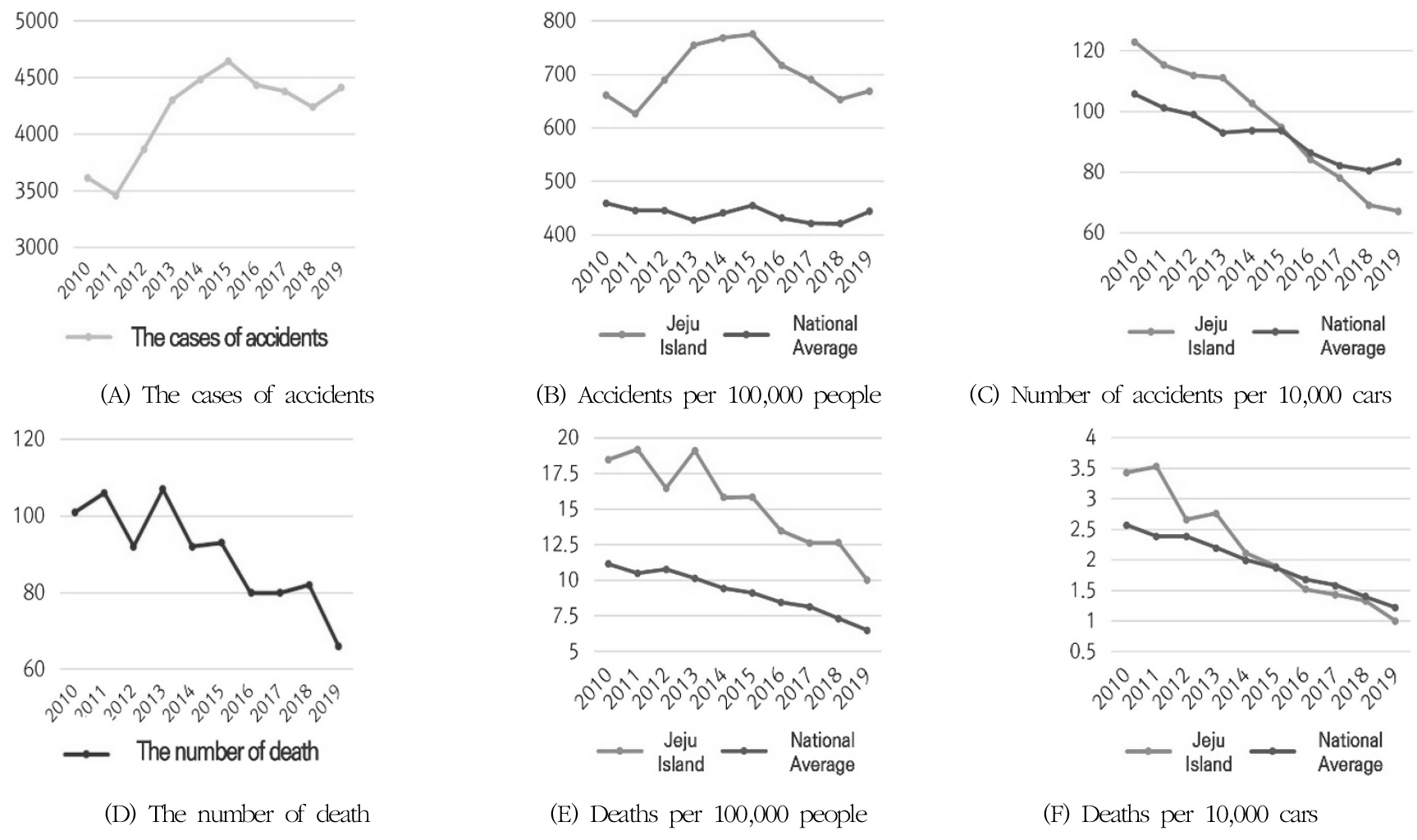
Considering Jeju Island’s social and safety accidents, traffic incidents and crimes account for a large proportion. First, the number of traffic accidents (Fig. 2) in Jeju Island is higher than the national average, and the figure continues to increase. The number of fatalities is higher than the national average, but the gap is narrowing. Although this is the result of changing the traffic safety system to be human-centered (safety speed 5030), this policy is aimed to curb pedestrian fatalities; however, this measure does not aptly improve the actual decrease in the number of traffic accidents. It is necessary to analyze Jeju Island as an effect on the number of traffic accidents in Jeju by considering the rate of use of automobiles by the tourist population due to the characteristics of the tourist destination. The ratio of tourists using cars is about 71.5%, of which the ratio of rental cars is about 86%, and the proportion of rental cars in Jeju compared to the nation also increased by about 34% in 2019 from about 3% in 2010. The number of traffic accidents in Jeju Island suggests that tourists that rent and drive are not well versed in local geography, so it is necessary to consider not only Jeju residents but also tourists when analyzing traffic accidents.
In the case of crime, we looked at the five major crimes (rape, robbery, murder, theft, and violence) in the National Police Agency's crime statistics, and the number of incidents showed a tendency to decrease or maintain overall. In addition, as a result of checking the level of community safety (social survey, KOSIS) perceived by Jeju residents, the perception of 2020 as being safer was higher than in 2010, but the perception of insecurity was still higher than the national average. Combining social disasters and safety accidents, it was confirmed that it was necessary to analyze traffic accident and crime indicators in consideration of the characteristics of the tourist-centric Jeju Island.
3) Analysis of Disaster Management System
In accordance with Articles 4, 24, and 34-4 of the Disaster and Safety Act, Jeju Special Self-Governing Province announces and implements a safety management plan annually. In the safety management plan for 2021, detailed plans for each disaster, safety accident, and event were established based on the Disaster Safety Act, and step-by-step measures were established to protect the safety of residents (Jeju Special Self-Governing Province, 2020). It is summarized in Table 4 according to the components of the determined resilience. Currently, Jeju Island seems to be in the stage of introducing smart disaster management as disaster situation reporting and judgment are being made through the national disaster management system and CCTV (Closed-circuited TV). In addition, from the perspective of governance, the current disaster management capacity strengthening plan only provides a method for public officials, so consideration of multiple actors including the public is insufficient.
Table 4.
Summary of key projects by Disaster Management Cycle in Jeju Island
4) Analysis of Smart Disaster Management and Safety-Related Projects Status
Jeju Island is actively promoting smart city-related projects, and is presenting a future vision for Jeju by promoting technological innovation based on data by planning a ‘smart island’ construction project. In 2020, the project was carried out in five areas: safety, traffic, environment, economy and administration. A smart control system was also introduced to prevent safety accidents. In addition, in cooperation with the Jeju National Police Agency, a big data social safety net service was prepared based on a cloud computing black box.
In 2021, the Smart Island project was centered on smart city and drone projects, and in particular, the establishment of a drone hub and commercialization of drone utilization services were actively pursued. Enhanced focus on operating and managing geospatial information systems, computerizing underground facilities, and building a digital twin-type river platform was demonstrated as well. The ‘Special Drone Free Zone’ designation was created and is taking the lead in using drone services by exempting it from regulations such as prohibition of flying in non-visible areas and prior flight approval. In particular, safety-related projects are being carried out to supplement the blind spots of CCTV and to respond to safety accidents in cooperation with the Fire and Safety Headquarters. The Jeju Free International City Comprehensive Plan (draft) announced in June 2021 also deals with disasters in strategy 1 out of 8 strategies. devised a strategy.
In order to improve the quality of life of residents and realize a sustainable city, the smart city project is being carried out by using a big data center to solve data-based urban problems and build a new industrial ecosystem. Not only are drones being introduced in order to supplement the existing limitations, but also various intelligent systems are being built. The details of the current status of smart disaster management and safety-related projects are summarized in Table 5.
Table 5.
Current status of smart city disaster and safety related projects in Jeju Island
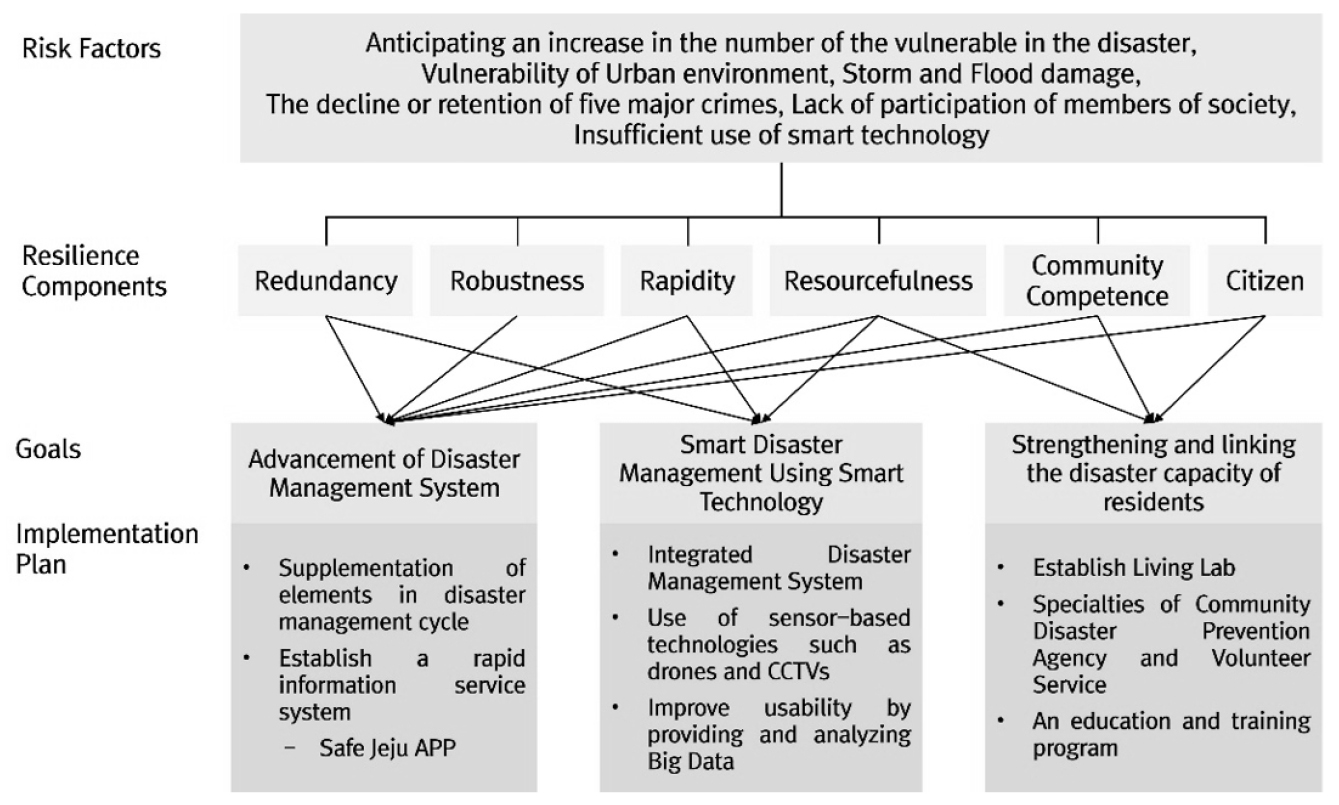
In this section, the current status of disasters and smart disaster management systems in Jeju Island were reviewed by annual statistical data trends, legal systems, and policies. As a result of synthesizing the disaster-related status of Jeju Island and arranging the risk factors of Jeju from the perspective of population, society, environment, et cetera, the increase trend of the disaster vulnerability, the increase in urban vulnerability due to development, wind and flood damage, and sustained level(or reduction) of the five major crimes was observed. This trend attributes to a lack of awareness and participation of members of society to respond to and respond to disasters, and insufficient utilization of various smart disaster management technologies. In order to improve this and ultimately strengthen disaster resilience, it is necessary to supplement the implementation strategy for each stage of disaster management, to improve the safety of the urban environment, to utilize smart technology, to prepare measures to reduce accidents, and to expand the number of training subjects to equip disaster capacity.
5. A Study on the Strengthening of Smart Disaster Management System Using Disaster Resilience
The purpose of this study was to examine how the local community strengthens the response plan for each stage of management before and after the occurrence of a disaster. Based on the discussion, we suggest three ways to improve disaster management by applying disaster resilience components: upgrading the disaster management system, smart disaster management using smart technology, and strengthening and connecting residents’ disaster capacity. Fig. 3 illustrates the relationships of these three aforementioned components
1) Advancement of Disaster Management System
In order to strengthen disaster resilience, it is important to have appropriate competencies according to the components of resilience (redundancy, robustness, rapidity, resourcefulness, community competence, and citizen) at each stage of disaster management: prevention, preparedness, response, and recovery. It is necessary to supplement the elements of each stage of disaster management by applying the concept of disaster resilience. Jeju Island is preparing strategies in terms of robustness, rapidity and resourcefulness; however, in terms of redundancy, it lacks preparation of alternative resources and in terms of citizens, and it is insufficiently ill-prepared for specific programs in relation to education and training. In order to supplement this, alternative resources such as manpower and infrastructure, as well as preliminary means, should be sufficiently prepared in the preparation stage to strengthen the relief system.
Second, it is necessary to prepare a system that can promptly deliver information on disasters and emergencies. It is important to establish a safe system in preparation for a disaster in advance, but it is likewise critical to quickly recognize the situation of a disaster. Although the Jeju Island Disaster Safety Countermeasures Headquarters website provides information on disasters such as the resident evacuation plan manual, action tips, and natural disaster risk improvement districts, it is limited to a fixed-scale map and it is difficult to recognize specific hazardous areas and evacuation routes.
Increasing the accessibility of the residents by synthesizing various disaster-related information is urgently necessary. Based on the organized contents, the Safe Jeju app (Table 6) must be developed to provide a groundwork that enables rapid information delivery and convenient access to information so that residents can participate in actual disaster situations.
Table 6.
Components of Safe Jeju APP
2) Smart Disaster Management Using Smart Technology
Smart disaster management refers to preemptive risk management by applying smart IT technology, quick and efficient on-site response and recovery, and maintaining the structure and function of society. In order to strengthen rapidity, redundancy, and resourcefulness by applying this, we would like to propose a method for establishing a smart disaster integrated management system using smart IT technology and preparing a senseor-based disaster service system.
First, smart IT technology is applied to establish an integrated disaster management system. The existing disaster situation management system refers to a system that supports decision-making by managers in disaster situations by using past disaster safety records4) and GIS (Geographic Information System). Smart disaster integrated management system is a system that applies smart IT technologies such as AI and big data and comprehensively considers information on disaster management resources.5) By applying this, resources can be rapidly inputted, and the manager’s decision-making can be supported by linking and synthesizing past disaster situations and resource management information. By synthesizing disaster-related information scattered in each system, it is possible to respond quickly in case of a disaster, and at the same time, it has the advantage of being able to manage disasters more systematically and efficiently by using smart technology. The initial system installation cost is high, and the introduction of a new system can cause business confusion.
However, if the system is well established, disaster-related information scattered in each system can be combined to respond quickly in the event of a disaster, and disasters can be managed more systematically using smart technology.
Second, a sensor-based disaster management system is established using intelligent CCTVs and drones. Considering the characteristics of an island region, Jeju Island can utilize data in advance to analyze areas that are likely to be inaccessible, select a location and area, install CCTV in advance, or utilize drones . An adaptive system in place allows rapid response and recovery in time of distress.
In addition, it is also critical to provide disaster-related data to analyze it from various angles and to predict risk or disaster resource demand to increase the usability of the data. It is imperative to increase the usability of big data by preparing an environment that can perform regional risk forecasting or disaster management resource demand forecasting by analyzing from various angles rather than ending with data provision. If you provide a space for citizens to share in the app proposed in ‘1) Advancement of the Disaster Management System’ to increase the connection between members of the local community and provide a place for exchange, it will enahance the usability of data and strengthen the community network at the same time.
3) Strengthening and Linking the Capacity of Local Communities and Citizens
In order to strengthen disaster resilience, the capacity of local communities and citizens with the ability to respond appropriately to disasters is most important. By reflecting the resilience components of citizens, community competence and resourcefulness a plan to expand the Living Lab,6) the Regional Autonomous Prevention Foundation, and disaster education and response training programs were proposed. First, the Living Lab should be expanded to various fields to increase citizen participation. Currently, Jeju Island is operating a Living Lab in the fields of renewable energy and shared mobility as part of the ‘2020 Jeju Smart City Challenge’. Since this does not play a role in disaster-related incidents, it is necessary to expand the field of Living Lab. Through the Disaster Safety Living Lab, it is necessary to create an environment in which residents can recognize risks, discover problems directly, and carry out a series of activities to mitigate and adapt to risks.
There is also a plan to improve the existing local autonomous prevention foundation and enhance professionalism based on the Living Lab. Since the existing regional autonomous prevention foundations are limited to specific genders and ages, the foundation will be laid to strengthen the local disaster safety network with a diverse and wide-inclusive participation. In addition, a safe community fostered and trained volunteers with the capacity to help the victims or respond to disasters in disaster situations are expected. Lastly, in order for such a network to operate well, education and training programs should be prepared according to the level of each member to recognize the risks that may arise in Jeju Island and to develop response capabilities. Currently, there is a ‘Jeju Safety Experience Center’7) in Jeju Island, but the focus is on experiences such as typhoons, earthquakes, and fires. In the future, it is necessary to expand the education program to equip disaster capacity and improve it into an experience center where both theory and experience can be learned. In addition, the program should not be limited to a one-time event, but should encompass a range from a comprehensive understanding to an event-specific awareness, and various program mediums such as offline and online should be prepared. These measures will help to raise the awareness of residents about safety accidents and disasters, and will equip residents with the ability to respond based on their understanding of disasters.
6. Conclusions
In this study, Jeju Island was selected as the target site for the purpose of strengthening disaster resilience in disaster management and enhancing the capacity of the local community based on citizen participation, and the current status of disaster and disaster management and related policies and projects were examined. In this process, the concept and components of disaster resilience were redefined and reorganized. Based on the analysis of the disaster situation in Jeju, areas that needed to strengthen disaster resilience in Jeju were identified and three reinforcement methods were suggested. This study suggests a way to strengthen the capacity of citizens and local communities through an understanding of the risks and disasters that can occur in the normal area and appropriate education and training programs. It is meaningful that the concept of disaster resilience that considers the capabilities of the local community was used.
However, in the process of analyzing the disaster status of the target site, it was not possible to analyze the characteristics of each region in detail and to determine whether the disaster conditions and risk factors of the target site are substantially correlated. This is due to a macro approach of considering the incidents as a whole that restrics incident-specific details, despite the various characteristics of each disaster. Nevertheless, the future research will analyze resilience and suggest practical reinforcement measures by applying a method to specifically identify the relationship between risk factors or standardizing indicators for disaster resilience analysis, which will better validate the results of the research.