

Research Article


구형모, 2010, Delineating Spatially Constrained Commuting Zones with an Improved Measurement for Functional Regionalization, 서울대학교 석사학위논문.
김을식・최석현・조무상, 2015, “기능지역(functional area) 개념을 활용한 지역고용 정책권역 설정에 관한 연구-수도권 지역을 중심으로,” 한국거버넌스학회보, 22(3), 189-215.
10.17089/kgr.2015.22.3.009이상일・김현미, 2021, “인구이동 플로의 연령-특수적 패턴 분석을 위한 방법론 연구-우리나라 시군구 단위 인구이동에의 적용,” 대한지리학회지, 56(5), 537-550.
10.22776/kgs.2021.56.5.537이상일・이소영, 2021, “인구이동 플로의 지리적 시각화를 위한 개념적 명료화: 우리나라 2020년 인구이동에 대한 주제도 제작,” 한국지도학회지, 21(3), 23-42.
10.16879/jkca.2021.21.3.023이상일・이소영, 2023, “인구이동이 인구재분포에 미치는 영향력의 시공간적 역동성 탐색: 우리나라 국내 인구이동에의 적용,” 한국지도학회지, 23(1), 1-19.
10.16879/jkca.2023.23.1.001이상일・조대헌, 2024, “우리나라 인구이동 데이터의 다양성과 상호보완성에 관한 연구-주민등록과 등록센서스 데이터의 비교를 중심으로,” 대한지리학회지, 59(4), 487-504.
이소영・배민철・주희선, 2023, “모바일 생활 통행데이터를 활용한 일간 인구이동 패턴 및 영향요인 분석: 경상남도의 직장인구와 방문인구 비교를 중심으로,” Journal of Korea Planning Association, 58(2), 5-21.
10.17208/jkpa.2023.04.58.2.5이재건・이건학, 2022, “코로나 19에 따른 도시 내 인구 이동 변화 탐색-서울시 생활이동 데이터에 기반한 통근 패턴을 중심으로,” 한국도시지리학회지, 25(2), 15-32.
10.21189/JKUGS.25.2.2제갈영, 2012, Delineating Housing Market Areas in the Seoul Metropolitan Area Using a Geo-computational Approach, 서울대학교 석사학위논문.
Alastal, A. I. and Shaqfa, A. H., 2022, GeoAI technologies and their application areas in urban planning and development: Concepts, opportunities and challenges in smart city (Kuwait, study case), Journal of Data Analysis and Information Processing, 10(2), 110-126.
10.4236/jdaip.2022.102007Aydin, O., Janikas, M. V., Assunçao, R. and Lee, T.-H., 2018, SKATER-CON: Unsupervised regionalization via stochastic tree partitioning within a consensus framework using random spanning trees, Proceedings of the 2nd ACM SIGSPATIAL International Workshop on AI for Geographic Knowledge Discovery, Seattle, November 6, 33-42.
10.1145/3281548.3281554Aydin, O., Janikas, M. V., Assunção, R. M. and Lee, T.-H., 2021, A quantitative comparison of regionalization methods, International Journal of Geographical Information Science, 35(11), 2287-2315.
10.1080/13658816.2021.1905819Assunção, R. M., Neves, M. C., Câmara, G. and da Costa Freitas, C., 2006, Efficient regionalization techniques for socio‐economic geographical units using minimum spanning trees, International Journal of Geographical Information Science, 20(7), 797-811.
10.1080/13658810600665111Bahdanau, D., Cho, K. and Bengio, Y., 2014, Neural machine translation by jointly learning to align and translate, arXiv Preprint, arXiv:1409.0473.
Bengio, Y., Courville, A. and Vincent, P., 2013, Representation learning: A review and new perspectives, IEEE Transactions on Pattern Analysis and Machine Intelligence, 35(8), 1798-1828.
10.1109/TPAMI.2013.50Chen, F., Wang, Y.-C., Wang, B. and Kuo, C.-C. J., 2020, Graph representation learning: A survey, APSIPA Transactions on Signal and Information Processing, 9, e15.
10.1017/ATSIP.2020.13Chen, Y., Liu, Q., Yang, J., Cheng, X. and Deng, M., 2024, Spatially constrained statistical approach for determining the optimal number of regions in regionalization, International Journal of Geographical Information Science, 38(10), 2108-2147.
10.1080/13658816.2024.2372779Duque, J. C., Anselin, L. and Rey, S. J., 2012, The max‐p‐regions problem, Journal of Regional Science, 52(3), 397-419.
10.1111/j.1467-9787.2011.00743.xDuque, J. C., Ramos, R. and Suriñach, J., 2007, Supervised regionalization methods: A survey, International Regional Science Review, 30(3), 195-220.
10.1177/0160017607301605Dwivedi, V. P. and Bresson, X., 2020, A generalization of transformer networks to graphs, arXiv Preprint, arXiv:2012.09699.
Grekousis, G., 2019, Artificial neural networks and deep learning in urban geography: A systematic review and meta-analysis, Computers, Environment and Urban Systems, 74, 244-256.
10.1016/j.compenvurbsys.2018.10.008Guo, D., 2008, Regionalization with dynamically constrained agglomerative clustering and partitioning (REDCAP), International Journal of Geographical Information Science, 22(7), 801-823.
10.1080/13658810701674970Guo, D., 2009, Flow mapping and multivariate visualization of large spatial interaction data, IEEE Transactions on Visualization and Computer Graphics, 15(6), 1041-1048.
10.1109/TVCG.2009.143Halkidi, M., Batistakis, Y. and Vazirgiannis, M., 2001, On clustering validation techniques, Journal of Intelligent Information Systems, 17, 107-145.
10.1023/A:1012801612483Huang, X., Wang, S., Wilson, J. and Kedron, P. (eds.), 2025, GeoAI and Human Geography: The Dawn of a New Spatial Intelligence Era, Springer, Cham.
10.1007/978-3-031-87421-5Kim, S. and Lee, S.-I., 2025, An extension of migration effectiveness indices: Accounting for the impact of migration on population structure, Population, Space and Place, 31(5), e70049.
10.1002/psp.70049Kipf, T. N. and Welling, M., 2016, Semi-supervised classification with graph convolutional networks, arXiv Preprint, arXiv:1609.02907.
Kreuzer, D., Beaini, D., Hamilton, W., Létourneau, V. and Tossou, P., 2021, Rethinking graph transformers with spectral attention, Advances in Neural Information Processing Systems, 34, 21618-21629.
Lattimer, B. and Lattimer, A., 2022, Creating compact regions of social determinants of health, arXiv Preprint, arXiv:2209.11836.
Li, Y. and Moura, J. M., 2020, Forecaster: A graph transformer for forecasting spatial and time-dependent data, ECAI 2000: 24th European Conference on Artificial Intelligence, Santiago de Compostela, 29 August-8 September, 1293-1300.
Liang, Y., Zhu, J., Ye, W. and Gao, S., 2022, Region2Vec: Community detection on spatial networks using graph embedding with node attributes and spatial interactions, Proceedings of the 30th International Conference on Advances in Geographic Information Systems, Seattle, November 1-4, 1-4.
10.1145/3557915.3560974Liang, Y., Zhu, J., Ye, W. and Gao, S., 2025, GeoAI-enhanced community detection on spatial networks with graph deep learning, Computers, Environment and Urban Systems, 117, 102228.
10.1016/j.compenvurbsys.2024.102228Mai, G., Janowicz, K., Hu, Y., Gao, S., Yan, B., Zhu, R., Cai, L. and Lao, N., 2022, A review of location encoding for GeoAI: methods and applications, International Journal of Geographical Information Science, 36(4), 639-673.
10.1080/13658816.2021.2004602Openshaw, S., 1977, A geographical solution to scale and aggregation problems in region-building, partitioning and spatial modelling, Transactions of the Institute of British Geographers, 2(4), 459-472.
10.2307/622300Plane, D. A., 1984, A systemic demographic efficiency analysis of US interstate population exchange, 1935-1980, Economic Geography, 60(4), 294-312.
10.2307/143435Rampášek, L., Galkin, M., Dwivedi, V. P., Luu, A. T., Wolf, G. and Beaini, D., 2022, Recipe for a general, powerful, scalable graph transformer, Advances in Neural Information Processing Systems, 35, 14501-14515.
10.52202/068431-1054Roy, J. R. and Thill, J., 2004, Spatial interaction modelling, Papers in Regional Science, 83(1), 339-361.
10.1007/s10110-003-0189-4Smith, T. R., 1984, Artificial intelligence and its applicability to geographical problem solving, The Professional Geographer, 36(2), 147-158.
10.1111/j.0033-0124.1984.00147.xVaswani, A., Shazeer, N., Parmar, N., Uszkoreit, J., Jones, L., Gomez, A. N., Kaiser, Ł. and Polosukhin, I., 2017, Attention is all you need, Advances in Neural Information Processing Systems, 30, 5998-6008.
Veličković, P., Cucurull, G., Casanova, A., Romero, A., Lio, P. and Bengio, Y., 2017, Graph attention networks, arXiv Preprint, arXiv:1710.10903.
Veličković, P., Fedus, W., Hamilton, W. L., Liò, P., Bengio, Y. and Hjelm, R. D., 2018, Deep graph infomax, arXiv Preprint, arXiv:1809.10341.
Yang, X., Bo, S. and Wang, J., 2024, Classifying urban functional zones by integrating the homogeneity and structural similarity of POIs, Journal of Urban Planning and Development, 150(4), 04024052.
10.1061/JUPDDM.UPENG-5033Ye, X., Fang, S., Sun, F., Zhang, C. and Xiang, S., 2022, Meta graph transformer: A novel framework for spatial-temporal traffic prediction, Neurocomputing, 491, 544-563.
10.1016/j.neucom.2021.12.033- Publisher :The Korean Geographical Society
- Publisher(Ko) :대한지리학회
- Journal Title :Journal of the Korean Geographical Society
- Journal Title(Ko) :대한지리학회지
- Volume : 61
- No :3
- Pages :432-451
- Received Date : 2026-06-02
- Revised Date : 2026-06-28
- Accepted Date : 2026-06-29
- DOI :https://doi.org/10.22776/kgs.2026.61.3.432
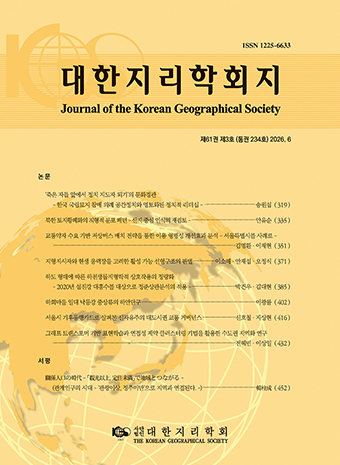 Journal of the Korean Geographical Society