


1. Introduction
2. The Transformation of the Developmental State and the Emergence of Post-developmental Corporate Strategy?
1) Pluralization in global capitalism
2) Positioning Korean developmentalism in variegated capitalism
3) The developmental corporate strategy: Compliance with the state and internalization of corporate activities
3. The General Characteristics and Development Paths of the Semiconductor Industry in Korea
1) Characteristics of the semiconductor industry
2) State-led development of the semiconductor industry in Korea
3) The Chip War and reinforcing the role of the state
4. Sustaining the Developmental Corporate Strategy in Korean Post-developmentalism
1) State-compliant strategy: Making its own chips and sustaining a global leadership
2) Consolidating memory chips mass production structure of the Korean semiconductor industry
5. Conclusions
1. Introduction
When discussing the economic and industrial structure of South Korea(hereafter Korea), manufacturing and trade indicators are primarily used to illustrate the scale of Korea’s economy and its position in the world. Korea has developed industries predominantly in manufacturing sectors and has also created an export-oriented economy and industrial structure through its developmental state’s strategic industrialization program. The developmental state has been an influential concept for understanding and explaining the relatively fast industrialization and economic growth of East Asian countries. State-led economic development, bureaucratic autonomy, and public- private cooperation are the keywords that elaborate on the miraculous success of East Asian countries(Amsden, 1989; Johnson, 1982). In addition, the strategic economic aid and trade benefits provided by the US during the Cold War also contributed to the rapid economic growth of late industrialized countries in East Asia including Korea (Glassman, 2018).
From the late 1980s, however, changes began to appear in Korean state developmentalism. The end of the Bretton Woods system and the shift in US foreign economic policy-the conditions that enabled Korea’s rapid growth in terms of exports and trade- disappeared. In addition, the export boom in the 1980s and the rapid growth of power of chaebols to the state, weakened the developmental state’s autonomy and capability(Chang, 2006; Ji, 2011). Changes revealed explicitly due to the waves of globalization and neoliberalization in the 1990s, and the financial crisis in 1997 which disclosed the internal contradictions of state developmentalism and suggested that it is no longer effective in explaining the Korean developmental state. Despite shifts, there are multiple studies that the legacy of state developmentalism remains remarkably strong(Chu, 2009; Lim, 2018; Thurbon and Weiss, 2016; Wade, 2018). This study echoes the latter’s arguments and critically examine the conventional approach of the transformation of Korean state developmentalism. This is because the study understands that the changes of the Korean developmental state a gradual evolutionary process, characterized by a highly uneven and variegated pattern of change. It is, particularly, believed that corporate strategies continue to reproduce patterns established under state developmentalism, leading to the persistence of similar industrial strategy and structure.
This study delves into the reproduction of developmental corporate strategies with a focus on the semiconductor industry in Korea. To support the argument, this study critically engage with the structure and growth of the Korean semiconductor industry to reveal how developmental corporate strategies shaped its current memory semiconductor centric structure. To achieve this, following this introduction chapter, Chapter 2 critically elaborates the dichotomous approach to transformation of Korean state developmentalism by drawing on variegated capitalism literature. Chapter 3 outlines the characteristics and state-led growth trajectory of the semiconductor industry in Korea. Chapter 4 uncovers the reproduction of developmental corporate strategy through an examination of state-compliant and firms’ internalization strategy. Finally, Chapter 5 synthesizes the discussion and draws conclusions.
2. The Transformation of the Developmental State and the Emergence of Post-developmental Corporate Strategy?
Substantial changes have occurred in the global system of capitalism. The victory of US-led neoliberal governance accelerated the integration of economies through globalization with regard to both corporate production and international trade, whilst the emergence of supra- national organizations, such as the World Trade Organization(WTO) as well as transnational corporations(TNCs) has meant that the global economy is ever-more interdependent(Yeung, 1998). This integration of the global economies marked the start of neoliberal hegemony; however, the worth of an individual geography of the state that have been accumulated with specific socio-political relations within the state remain significant(Gong and Hassink, 2020; Park et al., 2012). Human geographers have focused on this by critically discussing capitalism and theorizing back to address its spatial unfolding and uneven development(Yeung, 2019). In addition, they have tried to grasp the dynamics and variegation of capitalist states, away from the deterministic theories of neoclassicalism (Peck, 2017; Sheppard, 2011; Yeung, 2023).
Capitalism has gone through constant stages of evolution rather than keeping to its original theoretical discourse and has produced new sets of spatial-temporal contexts(Fligstein and Zhang, 2010). The transformation of capitalism has also led to geographical changes because its momenta is highly related to spatial-temporal contexts in which capitalism can be reconstructed and unfolded. As a result, the geographical variegation of capitalism has become a research topic in economic geography, and various discussions pertaining to the dynamics forms of capitalist spatiality have emerged(Peck and Theodore, 2007). This study concurs with this research direction that focuses on pluralization of capitalism in a spatial context and particularly addresses variegated capitalist in ‘non-Anglophone Countries’, particularly the East Asian developmental state which have, to date, been relatively marginalized from economic geographic discussions(Yeung and Lin, 2003). This study examines Korean state developmentalism as one of variegations of capitalism within the diverse landscape of capitalist systems. It aims to trace its dynamic evolution, shedding light on post-developmental state following the developmental state. Rather than simply concluding that the developmental state has transitioned to a neoliberal post-developmental state, this study seeks to capture both its path dependency and its ongoing changes, emphasizing the highly uneven and variegated nature of its transformation.
1) Pluralization in global capitalism
Hyper-globalization and neoliberal globalization have become dominant discourses of the 21st century. At the empirical level, extensive international trade and cross- border investments demonstrate the integration of the global economy, and show how it has resulted in the consolidation of neoliberal hegemony and created a unipolar system of global capitalism(Park, 2020; Peck and Theodore, 2007; Peck and Zhang, 2013; Zhang and Peck, 2016; Yeung, 1998). Nevertheless, it is crucial to critically question whether such convergence of national economies and neoliberal principles has the same face beyond the spatio-temporal context. In other words, can the unipolar form of global capitalism imply various geographies of the capitalist states? And how should countries that are slightly out of the so-called orthodox capitalist state, such as East Asian countries, be interpreted?
There have already been attempts within existent literature to explain various forms of capitalist states that have also (slightly) highlighted the significance of geographies. Within the Comparative Capitalism(CC) literature, the pluralization of global capitalism begins with the claims that capitalism does not characterize only one particular kind of economic system. The discourse on such a unipolar capitalist system was criticized by Albert(1993) and Huntington(1996) for the differences in trajectories in the capitalist systems, regimes, and models. Commenting further, Albert(1993) argues that capitalism has no ego to reflect itself on how it should respond to unexpected and external shocks, and he suggests that there is a pluralization of capitalism, not a monolithic concept of capitalism. He characterizes global capitalism as a socially coordinated Rhine model and a neoliberal Neo-American model. The Rhine model prioritizes social consensus and the public interest and aims for a stable social-economic system, a model that has been widely adopted within continental European countries. The Neo-American model, on the other hand, puts individual interests before group interests and aims to vitalize the economic system through markets and financial system. This pluralization of capitalism by comparative approach led to discussions of a Variety-of- Capitalism(VoC) based on neo-institutionalism. Hall and Soskice(2001) provide an crucial way to understand global capitalism, which sought to try and develop categories that are useful to theorize and explain the growing diversity of capitalism across the world. VoC scholars are typically sceptical about global convergence discourses, and they contend that national economic circumstances are politically enabled, institutionally mediated, and socially embedded(Peck and Zhang, 2013). With the thoughts about geographies of economic system, they further suggest that national political economies could be identified and compared by reference to how firms resolve the problems in five spheres: Industrial relations, Education and training, Inter-firm relations, corporate financing and governance, and Employees(Peck and Theodore, 2007). The five strands of corporate institutional coordination classify a national political economic system into the binary form of the Coordinate Market Economy(CME)1) and Liberal Market Economy(LME).2)
This pluralization of capitalism raises questions as to whether simply dividing capitalism into systemic aspects would be sufficient to represent global capitalism. In the CME-LME continuum, Hall and Soskice(2001) make limitations in their endeavors to make a classification of capitalism in some points. For example, in dealing with the various systems of capitalism, the focus is on ‘variety’ rather than ‘capitalism’ per se. This represents the differences that exist between the various capitalist systems between the CME and LME with the corporate institutional differentiation; however, it dismisses the fundamental and structural interdependence that exists between disparate political economies and contingent convergence. In addition to this, though the VoC classifies capitalism through institutional diversity, they overlook the settings in which various institutions could occur at multiple geographic scales, such as the relationship which exist between the state and firm, the state and the local/region, and the local/region and firm. Instead, they reify the economic system by focusing on aspects of corporate activities such as corporate training, inter-firm relationships and wage settings(Lee et al., 2025).
With regards to the lack of consideration of geographical interconnections in global capitalism, there is a lot of North Atlantic state, so-called the Global North, centric thinking within this discourse. From an institutional economic context, however, it is questionable whether such Global North centric cases can represent ‘global’ capitalism; all of which are not the epitome of the so-called Western capitalist state. In addition, the classification of capitalism has been undertaken by focusing on current national territorial boundaries; an approach that could be prone to methodological nationalism and national reductionism (Dixon, 2011; Park, 2020). The VoC stresses capitalist variety at national-level by presenting the states that belong to the CME or LME; this may reduce a variety of capitalist features into the characteristics of the state and vice versa. It is necessary to consider the possibility that economic activities can jump between the scales and may also possess forms of spatial behavior at both national- and subnational-levels. For example, there is a number of cases which show TNCs strategically coupling with actors at subnational-level(Coe et al., 2004); this implies that the state is not the only container that can hold capitalism, and that capitalism can be sufficiently unfolded at both higher- and lower-level scales. Lastly, existent VoC literature recognizes capitalism as a static system. While acknowledging that institutional settings are not easily change and are hard to completely reverse in terms of institutional path dependency, there are some countries that have undergone significant changes over the past few decades. For instance, socialist countries such as Vietnam and China have already entered the global capitalist economic system and East Asian countries that allegedly belong to the CME countries as per the VoC literature are gradually incorporating into Anglo-American style capitalism(Brenner et al., 2010). It follows that since the state has ever-changing features, defining and stylizing complex capitalist states a binary categorization can oversimplify capitalism. In the same vein, even though Korea’s economic development model has undergone significant transformation, it cannot be neatly fit into these binary categorize as if it was a concluded matter.
2) Positioning Korean developmentalism in variegated capitalism
It is difficult to know everything about how capitalism unfolds in those countries that do not operate in line with the simply divided forms of capitalism. This can lead, especially, to countries in developing world and the Global South being marginalized. This observation, in turn, supports the critical point of view on the VoC that numerous kinds of capitalist states can exist simultaneously, and again highlights the importance of understanding the geographies of each country. Economic geographers have endeavored to grasp distinctive national and regional manifestations of capitalism and to appreciate the institutionally mediated and socially embedded nature of economic relations and structures(Dixon, 2011). From such a point of view, understanding of the bipolar system of capitalism is perceived as missing an essential source of geographical difference, and on top of that, the VoC fetishizes the national scale by failing to capture opportunities for institutional relationships and mobility resulting from economic activities at other geographical scales(Peck and Theodore, 2007). Since economic activities consist of the relationships that occur between (and of) actors and various geographical scales, it is necessary to understand the capitalist system by identifying institutions through a multi-scalar approach to economic activities on institutional vitality. Such a geographical understanding of capitalism fosters the need for an alternative approach to ‘Variegated Capitalism’ that underscores how the global system of capitalism is constitute by interconnection between national economies and the importance of examining supra- and sub-national connections.
Along with the demand for conjunctural and relational interpretations based on an uneven spatial unfolding of capitalism, the variegated capitalism framework offers different rubrics of capitalism to the VoC literature. According to Peck and Theodore(2007), variegated capitalism focuses on individual cases instead of classifying them, and thus interprets capitalism as a conjunctural analysis through the relative institutional and cultural political economy(Park, 2020). This approach to capitalism captures the moments of economic information and restructuring from specific vantage points rather than prevailing interpretation through the institutional model of the state, and thus attempts to establish a structural, multi-scalar, and geo-historical understanding of state- economy settlements. The variegated capitalism approach transcends the above mentioned limits of the VoC as it focuses on the fundamental and structural institutional settings of the national economic system rather than demonstrating and classifying capitalistic varieties. As a result, it identifies institutional contexts and relationships linked to actors at various scales. In addition to this, since it captures individual geographical features and conjunctures, it deviates from Global North centric perspectives which present more open and diverse perspectives compared to the VoC’s static view of capitalism because it is an approach that can grasp the dynamic and evolutionary points of global capitalism.
Korean developmentalism could potentially be categorized as part of the CME within the VoC approach. And it is true that Korean state developmentalism has shifted towards the LME model, as described in the VOC literature, particularly after the 1997 financial crisis and following neoliberal prescriptions. Nevertheless, the comparative capitalism discussion has its clear critical points of oversimplification to view this change as a compete transition from the CME to LME. This is because, while many economic and industrial policies at the national-level have indeed undergone neoliberalization(Doucette, 2016), the process and manner of their implementation still reveal elements of state developmentalism. Furthermore, in terms of corporate strategies, a full transition to the LME would typically involve a shift towards more market- friendly and globally integrated corporate strategies. Yet, Korean firms, especially those in key strategic industries, continue to exhibit developmentalist characteristics. These characteristics are even being reproduced in response to international geopolitical and geoeconomic landscape. Therefore, rather than understanding the transformation of Korean state developmentalism within a binary framework of the CME and LME, it would be more accurate to view it as one of variegated forms of capitalism that reflects distinct geographical and conjunctural specificities.
3) The developmental corporate strategy: Compliance with the state and internalization of corporate activities
The developmental state concept was conceptualized through the case of Japan and shed light on the rapid economic growth and industrialization of late-industrialized countries in East Asia. Thereafter, lots of related research was conducted between the late 1980s and the early 1990s(Amsden, 1989; Evans, 1995; Haggard, 1990; Johnson, 1982; Wade, 1990; World Bank, 1993). With such studies, the developmental state is used as a generic term to explain the rapid economic growth of East Asia and a range of factors pertaining to its emergence are generally agreed upon by scholars. With regard to internal factors, it is suggested that there is strong leadership with elite bureaucrats independent and autonomous from social forces(Haggard and Moon, 1983), whilst with regards to external factors, there are the Cold War alliance with the US(Woo-Cumings, 1999), and favorable international trade condition for the US market(Lim, 2018). Furthermore, for ideological factor, there are nationalist and neo-mercantilist state ideologies that set economic growth and industrialization as the top of goals and rationale for individual regimes(Haggard, 2004; Stubbs, 2009).
Such characteristics, particularly, neo-mercantilist state ideology led to the emergence of developmental approach for a corporate strategy. The developmental government put economic growth at the top of those agenda to overcome poverty in Korea. In the 1960s and 1970s, the Park Chung-hee administration established an export-led strategy that introduced capital and raw material from abroad, processes with domestic cheap labor, produced goods, and exported them back to foreign countries. The quantitative expansion of the industry through input production factors accelerated further with the country’s transition to capital intensive heavy and chemical industrialization in the 1970s. Along with low labor costs, funds raised by overseas loans were invested in steel, petrochemical, electronics, machinery, and shipbuilding sectors, and huge subsidies were given to those industries and companies favored by the central government(Choi, 2007). This government-led and neo-mercantilist approach constituted the Korean developmental corporate strategies.
The developmental corporate strategy that sought to improving the national trade balance based on neo- mercantilism saw successful in achieving its goals(Lim, 2018). For example, vertical and horizontal integration strategies, traditional concepts based on transaction cost theory, were considered useful in the developmental state corporate strategies because they could effectively reduce transaction costs. This strategy forced firms to internalize production processes to improve the country’s trade balance, whilst also resulting in the expansion of the scope of the individual businesses. Korea had no reason not to adopt this strategy since the national champions covered multiple sectors simultaneously. Nevertheless they were not capable of producing all equipment and materials that were required since lots of capital and intermediate goods had to be imported from advanced industrialized countries. So the Korean government wanted to curb imports by developing heavy and chemical industries(Baek, 2004). A similar problem, however, also arose in the heavy and chemical industrialization program because the Koran firms still relied on overseas suppliers to import capital and intermediate goods.
With regards to reducing imports of intermediate and capital goods and gaining cost competitiveness for final products, firms imported cutting-edge technologies from advanced countries. Technology transfer was recognized as the most cost-efficient and rapid method of achieving technological innovation, and countries such as Japan and the US played a significant role in facilitating technology transfer(Ryu and Lee, 2003). In addition to technology transfer, the government established policies to produce equipment and materials domestically, and the companies participate in this policy agenda. Thank to this policy direction, the national champions expanded the scope of their businesses by establishing or acquiring equipment and material production companies(Cummings 1987). Through this internalization strategy, the national champions were able to attain economies of scale, grow into chaebols and become global lead firms in their respective industries.
After democratization and the financial crisis, the Korean state has undergone significant changes. There might be less state autonomy and capability due to democratization and neoliberalization, and the state’s focus could be shifted from solely pursuing national goals to considering expanded agreements among various social forces and relations with other countries. It reflects a transition from state developmentalism to post-developmentalism that follows neoliberal principles. Corporate strategies have adapted to these changes; however, that adaptation seems to be happened slowly due to the strong institutional dependency of the developmental state. By sustaining and depending on this successful path, the state and firms can continue to work towards achieving their export growth targets while strengthening their competitive edge in the global market. In other words, the Korean state and firms are adapting to the new global environment based on this developmental path, gradually modifying the path and moving towards post-developmentalism. Consequently, the developmental corporate strategy have not fully embraced neoliberalization. Some have partially integrated into neoliberal frameworks while retaining developmentalist elements. Others, however, are actively reproducing and maintaining developmental characteristics.
3. The General Characteristics and Development Paths of the Semiconductor Industry in Korea
There is saying that refers to semiconductors as the ‘rice of industry’, implying that just as rice a staple in Korean cuisine, semiconductors are indispensable in virtually every industry. As information and communication technologies have evolved around the internet and mobile devices, semiconductors have become essential components. Particularly, the mobile revolution in the late 2000s and a result of Covid-19 in the early 2020s led to a sharp increase in demand for electronic products and the electrification of machinery; driving up the demand for semiconductors. Semiconductors are major exports item for Korea, and constitute a significant portion of the country’s export economy. The Korean state has adopted an export-led industrial strategy from the past to present, managed its major export items institutionally and policy- wise, and responded sensitively to changes in the industrial environment.
1) Characteristics of the semiconductor industry
Semiconductor are essential parts for almost all industries, and their importance is growing especially with the development of information and communication technology. Semiconductor are divided into integrated Circuit(IC) and discrete component, commonly referred to as chips means IC chips. The global semiconductor market is divided into memory semiconductors and system (non-memory) semiconductors. Memory chips are responsible for storage functions, which includes DRAM and NAND flash as the primary products. On the other hand, system semiconductors handle computing and inference functions, encompassing Central Processing Unit(CPU), Application Power(AP), Image Sensors, AI Chips and other related products. In general, memory chips are important fields for production efficiency and process innovation for the cutting-edge products, and system semiconductors are important fields for design capabilities. Korean firms are leading semiconductor manufacturing and export and as shown in Table 1, Korean firms holds over 16% of the global market share in semiconductor industry and is specialized in the memory chips, whilst the US shows strength in non-memory semiconductors. Such imbalances have been pointed out as weaknesses in the current semiconductor trade tensions; Korea is presently working on advancing its non-memory sector, while the US is pushing for expansion of its memory semiconductor product lines.
표 1.
The top 5 semiconductor companies by market share as of 2024
Source: Gartner(2025)
In terms of general characteristics of the semiconductor industry, chip production process is highly segmented, with specialized companies being involved in each process. As their geographical locations have become globalized and interconnected, the global production networks of semiconductor firms have been consolidated. The semiconductor manufacturing process is divided into three major stages of design, fabrication and packaging and test. The semiconductor design is mainly carried out at fabless in advanced industrialized countries, and then the chip design is transferred to professional foundries that are consigned to mass production. The consignment mass production of chips is common in East Asin countries, and representative companies are TSMC in Taiwan and Samsung Electronics in Korea. The packaging and test process is in charge of chip assembly and testing and is mainly in East Asian countries as well. This production process is mainly for a system semiconductor production ordered from demand companies, and its outstanding feature is that it is vertically disintegrated and specialized and globalized in each process. There are also integrated device manufacturers(IDM) that have all of these processes. IDM is carried out in a vertically integrated in-house process from design to test and representative examples are Samsung Electronics and SK Hynix in Korea and Micron Technology Inc. in the US. These companies are mainly focusing on producing and developing cutting-edge memory chips.
The industrial fragmentation and global production networks were not inborn feature of the semiconductor industry. In the early stages of the industry, IDM was a general business model. Chip design, fabrication, packaging and testing tended to be carried out in one company and one country; however, with the international relocation of chip production facilities in the 1970s and the emergence of foundries in the 1980s, the semiconductor industry started to become vertically disintegrated. Existing IDMs in the advanced economies began to switch their business model to fabless, and chip production was left to professional foundry companies in Asian countries. As semiconductor design and production functions were separated, a more favorable environment was created for latecomers to enter the semiconductor sector. The latecomers were able to participate in the semiconductor industry while taking a relatively low-tech process, and they were able to expand the scope of their individual businesses by developing their own technologies and networking with other industries. In the case of Korea, although it was not an industrial country in the early days of semiconductors, its industrial structure was formed mainly around IDM. The reason for this is that the Korean semiconductor industry grew as an integral part of the electronics industry. Korea, which nurtured the electronics industry as an export-led industry, expanded its business- scope to electronic equipment and parts manufacturing, and in the process, the semiconductor industry developed through mass investment by the state and electronics companies. This unique aspect of developmentalism provided Korean firms with the global competitiveness that it exhibits today, and represents a legacy of state developmentalism.
2) State-led development of the semiconductor industry in Korea
Korea’s semiconductor industry has been subjected to state-led policy decisions and transitions. During the phase when the state actively was nurturing industries, it did not solely target semiconductor production but established and implemented policies to foster the electronics industry. In the 1960s, with the ultimate goal of expanding exports, the Korean developmental state established various strategies for nurturing the electronics industry. For example, in 1969, the enactment of the Electronics Industry Promotion Act and the Electronics Industry Export Promotion Roundtable helped to assess the reality of the Korean electronics industry and explore specific nurturing plans(Park, 2021). Subsequently, in the 1970s, and as part of the heavy and chemical industry nurturing program, the electronics industry was designated one of the six strategic industries. The nurturing of the electronics industry prioritized export. Until the early 1960s, there was a lack of a dedicated government department for electronics, which reflecting the minimal recognition of the industry; however, once it was designated as a major export industry, it began to receive direct benefits from the state. Specifically, under the individual industrial promotion acts, financial and tax support were provided, and loans were made available through the enactment of the National Investment Fund Law which supported the Electronics Industry Promotion Fund for investment in the industry. This support was limited to companies located in the Gumi Electronics Industrial Complex, and was based on the Electronics Industry Promotion Act(Kim, 1998); indicating the government’s significant recognition of the importance of investing in specific sectors and regions. In addition to this, in 1977, the establishment of the Korean Electronics Telecommunications as the exclusive manufacturer of electronics switches reflected the state’s direct involvement and desire to nurture the electronics industry through a state-owned or state-governed firm.
The electronics industry was given a specific target by the Korean developmental government to achieve USD 10 billion in exports in 1980. According to Table 2, the goal was set through the ‘Long-term development plan of the electronics industry’ to export USD 2.5 billion in 1980. The goal was presented in high details, such as the export ratio by region and the production ratio by item. In addition, the Ministry of Commerce and Industry tried to increase export competitiveness as well as domestic consumption through lowering the price of electronic products by 20~30% by lowering the commodity tax rates of some home appliances such as TVs, fridges and air conditioners. A notable point here is that pure foreign capital investment for the Korean electronics industry accounted only for 10%. This is significant to note because it suggests that the Korean state preferred to use joint investments to control the dominance of foreign capital over the domestic electronics industry and companies. It indicates the strong foreign control exterted by the state.
표 2.
The Korean electronics industry target model in 1980
Source: Adopted from Ministry of Commerce and Industry of Korea(1973);Author’s modification
The emergence of policies directly related to semiconductor production began in the mid-1970s. After deciding to expand investment in research and development in the electronics industry, particularly in semiconductor and computer, the government began to lead technological advancement in the industry(Wade, 1990). The government instructed the Korea Advance Institute of Science and Technology(KAIST) to prioritize semiconductor technology development as a top project. Additionally, it provided financial support to semiconductor manufacturing companies, and expanded financial benefits such as bank credit funds and tax incentives for this purpose as well as matching funds(Kim, 1998). Even after the shift in focus on the semiconductor sector, the role of the state appeared largely unchanged. The government established the Electronics Industry Promotion Association to facilitate a collaborative framework that involved public-private- research sectors in the long-term industrial promotion plan. It set a policy for component and material development, and sought to secure domestic component supply rate of 70% by 1991(Kim, 1998), and provided institutional support to relevant companies in a manner similar to previous noted approaches. During this period, while promoting the globalization of industrial policies in preparation for Korea’s accession to the OECD and the rise of WTO system, the semiconductor industry remained an exception. The Korean government showed clear policy intention by setting the promotion of the semiconductor industry as one of its national goals and by taking a keen interest in its development. Additionally, the government almost monopolized technological and industrial information through national research institutes, which demonstrates that the state had an exceptional status to advance industry beyond the private sector.
3) The Chip War and reinforcing the role of the state
The chip war in the 2020s can be seen as being a competition between the US and China for semiconductor hegemony. Competition between the US and China is taking place not only with regard to semiconductors but also in the industry as a whole, but the semiconductor sector is at the core of the conflict because they are tied into issues of national economic security. As a result, the competition for hegemony over the sector should not be viewed simply as a competition for industrial leadership, but as a geopolitical and geoeconomic tensions that includes national security and international relations. As the US strengthened its protectionist stance against China, semiconductors were used as a weapon in trade negotiations; a situation that also affected the Korean semiconductor firms too. For instance, in 2018, as part of its negotiation strategy amid its trade dispute with China, the US demanded as increase in imports of US-made chips; thereby displacing Korean chips imports(Mitchell and Fleming, 2018). The tensions between the US and China have had a significant impact on Korean semiconductor sector due to the fact that both countries are major trading partners for Korean chips. According to Bank of Korea (2023), more than half of Korean chips exports were to China, with the US accounting for about 10%. Furthermore, regarding supply side matter, semiconductor materials, components and equipment are also intricately intertwined. For instance, Korea’s dependency on China exceeds 80% for hydrogen flouride, and its dependency on the US exceeds 90% for ion implanters. Due to the high dependency on specific materials and equipment from both China and the US, any friction between these two countries inevitably has negative impact on the sector. With this complex geoeconomic tensions, it becomes a matter beyond firm level so the Korean state needs to involve in the matter with cooperation with semiconductor firms. This implies that the chip war has reframed the role of the state to the extent that former characteristics of state developmentalism have once again become important.
4. Sustaining the Developmental Corporate Strategy in Korean Post-developmentalism
The goal of the strategic industrialization program in the Korean developmental state was to establish the national champions; large-scale capital companies that would contribute the state’s economic and exports growth. Only a few large companies, however, were able to participate in the program due to the government’s preference for specific companies which would become global lead firms in each sector. While it is undeniable that the government played a significant role in the initial growth of these companies, the reproduction of developmental corporate strategies were also crucial to securing their current global positions. For instance, to become the national champions and global lead firms, the electronics companies in Korea had to align their corporate strategies with the government’s industrial policies and strategies. Since the electronics industry involve comprehensive assembly processes that rely on supply chains to ensure profitability, the government’s goal of surging exports and corporate strategies were in sync.
1) State-compliant strategy: Making its own chips and sustaining a global leadership
The semiconductor industry, which is classified as a high technology manufacturing industry, followed the typical path of the technology transferring from advanced economies. Initially, the semiconductor industry in Korea was only involved in simply assembly processes with low technological sophistication. In the 1960s, the US-led semiconductor industry sought to improve productivity by separating the technology-intensive wafer fabrication process from labor-intensive assembly process, and some assembly lines were relocated in Korea, where labor costs were relatively low and policy benefits could be enjoyed. The first semiconductor company in Korea, Komi Electronics Ltd. was established in 1965 through a joint venture with US firms of which the investment ratio of domestic and foreign capital was 75:25, with USD 76,000. Over the new few years, US semiconductor firms Fairchild Semiconductor Ltd. invested USD 2 million, and Signetics Corporation invested USD 1.5 million to establish a production company in Korea(Hyun, 2016). These companies were responsible for producing semiconductor components and taking the final process of transistor production, using cheap domestic labour. During the 1960s and 1970s, Korea’s semiconductor industry acted like a global semiconductor assembly line that produced transistors, integrated circuits, diodes and memory chips(Kim et al., 2015). This served as an opportunity for Korean companies to acquire production know-how and expertise. Since Korea’s semiconductor industry had no industrial experience at all, there was no way to nurture the industry except to introduce advanced foreign technologies. This was achieved through establishing cooperation with foreign firms.
Thereafter, rising prices and labour costs cause by the oil shocks in the 1970s led US firms to reduce their investment in Korea, and domestic electronics firms began to replace the void which that retrenchment had created. In the 1980s, the Korean government implemented policies to support developing the country’s own semiconductor technology with basic skills acquired through production experiences and the technology gap was narrowed. One example of such government institutional involvement was the joint development project for ‘Ultra-high Integrated Semiconductor Technology’, which sought to develop DRAM. DRAM was a suitable development item for initial entrants in the semiconductor sector as it is simpler to design and produce than other IC chips and can be mass produced. As shown in Table 3, the project was conducted via private-public collaboration, and took advantage of DRAM controlled by Electronics and Telecommunication Research Institute(ETRI). As a result of the project, Korea succeeded in developing 4MB DRAM a little later than US and Japanese firms, with the 16MB DRAM completed at a similar time. With regards to 64MB DRAM, Korea developed faster than the countries, and succeeded in achieving innovation in cutting-edge technology.
표 3.
National projects for developing and producing memory chip
Source: Adopted from Kim et al.(2015); Author’s compilation and modification
The role of the Korean developmental state was still emphasized and semiconductor companies had cooperative stance until the technology introduction strategy reached its final stage. In particular, the ETRI, which was in charge of the central control of the project, was given the authority to select participants, allocate budgets, and evaluate projects, and additionally encouraged private companies to cooperate rather than compete against each other; thereby emphasizing that this project was a presidential project for the national interest. When the 4MB DRAM plan was implemented in 1986, the government was still a military dictatorship, and related policy documents stated that the ETRI director should take over the authority over human resources of all researchers, and that the three private participants should cooperate under the direction of the head of the institute(Kim et al., 2015). The project carried out on the national scale can be seen as evidence not only of the government’s willingness to develop semiconductor technology, but also as evidence of risk of private firms with insufficient technology base and financial resources instead. The basic technology and competition of the companies participating in the project might also have played an important factor in technology development, but crucially, the government’s supportive role was significant in making leading players in the memory chip sub-sector. This, in turn, enable it to take first mover advantages3). The national strategy of nurturing a specific industry in catching up with the technologically advanced economies allowed for the rapid development of the semiconductor industry. Leveraging production know-how and technology, the Korean semiconductor industry was able to become a global leader in the memory chip sector.
Following the financial crisis in 1997, the Korean government adopted a neoliberalized economic system characterized by macroeconomic austerity, openness and the liberalization of foreign exchange, capital and trade (Yoon, 2009). The Korean state became the so-called post-developmental state. These institutional changes created a more challenging environment for state intervention in semiconductor industries and companies, as the state’s role was reduced in favor of market-oriented policies. At the same time, Korean semiconductor companies became global leaders, and the globalization of business activities emphasized the importance of corporate capability and global networks. Despite these changes, the state is supposed to still play a crucial role and the companies comply with the state’s decisions. For example, to address global semiconductor competition and tensions in the 2020s, the Korean government legislated and implemented comprehensive policies to foster and promote the semiconductor industry, such as the construction of new semiconductor-specialized industrial complex, tax benefits and infrastructure construction. These government beneficiary roles are reminiscent of the specific measures implemented over the industrialization program in the 1970s. In other words, the government’s policies have taken the lead, and companies have responded by adopting policy-aligned strategies. This approach, aimed primarily at advancing technologies such as system and AI semiconductors, reflects the continued presence of a corporate stance that conforms to state direction.
For such state-compliant strategy, the state autonomy of the Korean developmental state in semiconductor industry was quite extensive. This can be assessed by the government’s active policy decisions regarding the semiconductor industry, but more specifically, the developmental state of Korea had established a clear goal and the institutional framework and authority to achieve it. For example, in order to making its own semiconductor and the designation as an export strategic industry, the government gathered related companies to collect information and established specific policies and goals for the electronics industry. The Korean government used it capability to collect the necessary information for policymaking by just mobilizing private companies’ knowledge. At the same time, it was relatively easy to utilize the state autonomy to establish and implement policies aligned with national strategy because private sectors in the electronics industry at the time was very small and there was limited bargaining power to raise their own voice. The semiconductor related companies was not able to form their own interest group to negotiate with the government; rather, the government gathered them to collect their opinion and data. Such a state-compliant stance(maintained even after becoming a global leader) has effectively solidified into the strategic posture of Korean semiconductor firms.
2) Consolidating memory chips mass production structure of the Korean semiconductor industry
Since the 1990s, companies leading strategic industries have experience rapid development. This has propelled them to global leadership positions. Nevertheless, for a late industrialized countries like Korea, whether it has caught up with advanced industrialized countries remain a pertinent concern. If ‘catching up’ is defined the ability to participate equally in global competition with advanced industrialized countries, then it can be argued that Korea has indeed caught up with global lead firms and countries, and that post-developmentalism arrived in Korea(Chu, 2009), as evidence by its dominant presence in the memory chip sector. Nonetheless, when the overall business landscape is considered, Korea’s global competitiveness is primarily concentrated in the ‘producing’ process. In light of the fact that the Korean state has global competitiveness in the manufacturing industries, but, simultaneously, a manufacturing biased economic and industrial structure generates path dependence and lock-in effects in specific sectors and processes.
Looking at this through the Korean semiconductor industry, there still exist the developmental corporate strategy. With the intensifying global semiconductor competition of the 2000s, the industry began to specialized and divide into distinct segments. The production process for semiconductors, in particular ICs, comprises three distinct steps: design, wafer fabrication, and assembly and testing, and an IDM takes charge of the entire process. In Korea, the semiconductor industry has developed in a manner that is primarily centered on IDM, and is focused on the mass production of memory chips. This aligns with the state’s semiconductor development strategy that emphasizes economies of scale, and can clearly be identified by the industrial structure that centered on increasing exports and curbing imports. According to semiconductor statics by Statista, memory chips account for only about 30% of the industry’s market share, whilst system semiconductor, such as Logic, Micro components and Analog make up the remaining 70%. While the size of IC chips is growing in the semiconductor market as a whole, the market that the Korean semiconductor industry is focusing on is only 30% of the memory chip sector. It follows, that the Korean semiconductor industry has mainly grown in areas in which production technology is essential, whereas the area that require chip design have not been developed adequately. Furthermore, as specialization in processes and production networks becomes increasingly crucial, Korea’s semiconductor industrial structure that concentrates on producing memory chips has become more apparent. According to a Bank of Korea’s report in 2016, there has been a structural change in the global semiconductor industry in which the growth of specialized firms, such as chipless, fabless and foundry, has surpassed IDM which primarily focuses on memory chip producing. The chipless and fabless which emphasizes R&D, have grown nearly 20% over the last 30 years and fabless, which emphasize system semiconductor production, has grown about 10%, whilst IDM has gown only 5% during the same period(BOK, 2016). The growth rates of up-stream sectors are higher than other sub-sectors and IDM, indicating a shift towards a technology-oriented industrial structure.
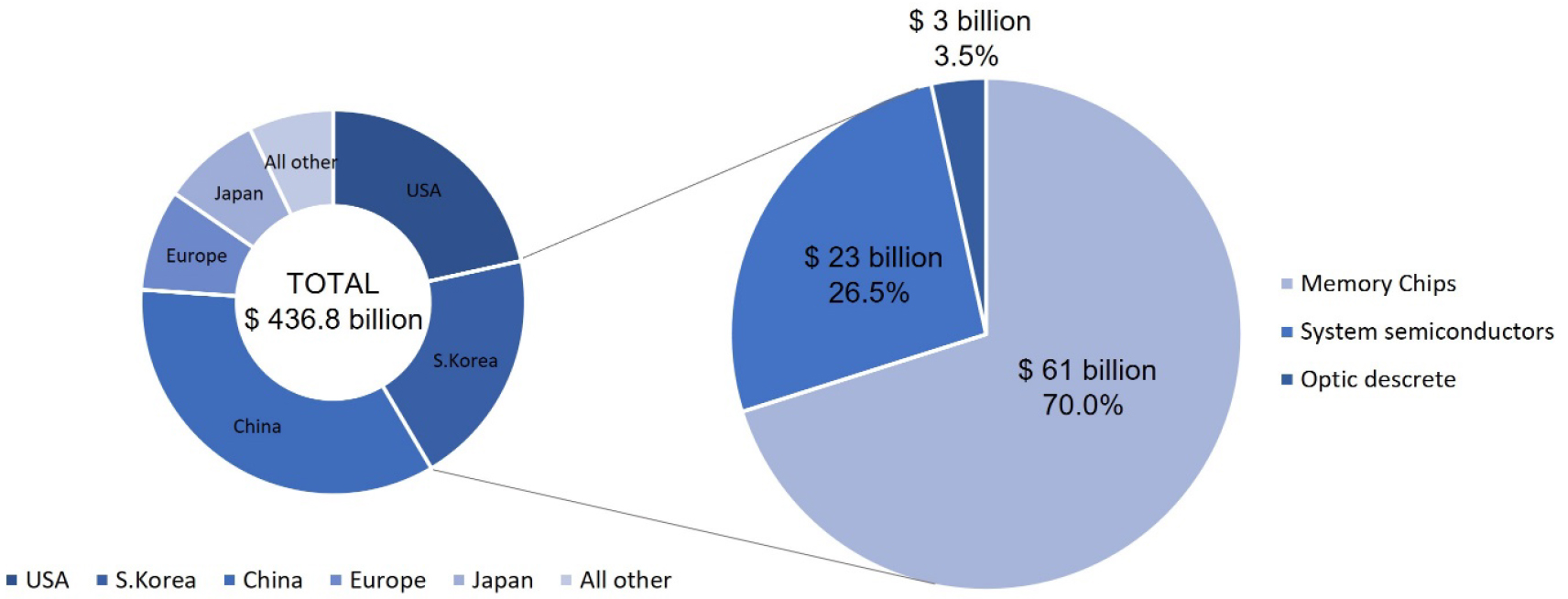
This memory chip centered production strategy led to an imbalanced industrial structure between memory and system semiconductor sectors. While memory chips, needed for computers, consumer electronics, and telecommunication devices, are produced and consumed in great number in-house, system semiconductor like micro components are largely imported. This lack of focus on developing the system semiconductors lead not only missing opportunities to meet consumer demands but also hindering the development of related machinery and materials sectors. This asymmetric semiconductor industrial structure has continued to the date. Figure 1 shows that the Korean semiconductor industry has grown a memory ships bias. As of 2020, the Korean semiconductor industry accounted for about 20% of the global semiconductor market. About 70% of the market share of 20% came from memory chips, and system semiconductors accounted for about 26%. This links to the profit structure of Korean semiconductor producers, about 90% of SK Hynix’s revenues and about 80% of Samsung Electronics DS division’s revenues come from memory chips. While this imbalanced industrial structure centered on memory chips did have positive impacts on rapid growth and export maximization, it also had significant disadvantages when it comes to reducing the industry’s ability to respond to risks such as the diversification of semiconductor demand and increasing global competition. Furthermore, as noted, there is a problem that core materials and equipment are still dependent on imports because the Korean semiconductor industry is specialized in producing memory chips. This is significant to note because it suggests that the Korean semiconductor industry seems to be locked-in the developmental corporate strategy that was created by collaboration between the developmental government and firms, which later consolidate neo-mercantilist developmental strategy that mass production and export is virtue for the national wealth.
It is not the case, however, that there was no opportunity to reorganize the structure centered on memory chips. The Korean semiconductor industry had the potential to specialize in the fabrication process, also known as Foundry, which produces system semiconductors according to the needs of Fabless firms. This was not actively pursued until the early 2000s due to the negative recognition of foundry firms as subcontracting businesses. Korean semiconductor producers neglected foundry process, whereas Taiwanese firms actively fostered foundry firms from the early 1980s. Samsung electronics, for example, was hesitant to be labelled as ‘Samsung Electronics is a foundry company’(Shim, 2005), as such, the company advocated IDM that has manufacturing processes from beginning to end. This led to stagnation in the domestic foundry sector, and is one of the reasons for ‘lagging behind’ development of system semiconductors compared to memory chips.
With the developmentalist approach that it should be manufactured from beginning to end, the Korean semiconductor industry missed its initial opportunity to grow system semiconductors; creating asymmetric industrial structure that now exists. This industrial structure of the Korean semiconductor sector, with its bias toward memory chips, is based on the path dependency of developmental corporate strategy, and resulted in locking in the state developmental approach that prioritizes mass export. this narrow focus on manufacturing has caused Korean firms to miss out on other opportunities to lead the up streams. In this regard, the answer the earlier question of “Has Korean firms, as a late industrialized country, caught up with advanced industrialized country?”, it can be said that at least the semiconductor sector, it has not caught up with advanced semiconductor countries. While the Korean semiconductor sector accounts for about 20% of global semiconductor market share, both the Korean state and firms have common concerns of catching up with up stream values like chip design and R&D in core materials and equipment with advanced corporate strategies.
5. Conclusions
There is a conventional discussion regarding the transformation of the Korean developmental state: the dismantling of the developmental state and transition to a neoliberal post-developmental state. The argument emphasizing the death of the developmental state is that Korea’s macroeconomic policies were greatly influenced by neoliberal principles, and that the expansion of free trade and the internationalization of production networks of Korean manufacturing companies have increased the impacts of the global market with the state’s institutions changed accordingly while the state’s developmental interventional roles disappeared. This argument, however, takes a dichotomous approach to whether or not Korea conforms to the definitive neoliberal post-developmental state. This study stresses that it is not that crucial to highlight whether the Korean developmental state has transitioned to a neoliberal state, and instead, the persistent developmental characteristics that remain within the variegated transformation process as Korean developmentalism undergoes changes.
Despite the significant changes of the Korean developmental state after the financial crisis in the late-1990s, the developmental legacy and path dependency can be found when one looks at corporate strategies. This study finds that the semiconductor industries employs an internalization strategy that seeks to manage everything from parts to final goods in-house. This strategy aims to minimize component imports and maximize exports and profits; reflecting developmental and neo-mercantilist intents. This strategy has led to reproduction of memory chip mass production strategy; facilitating co-growth with domestic upstream and downstream electronics industries. This reproduction of the developmental corporate strategy suggests that rather than shifting towards market-oriented strategies with the emergence of post-developmentalism in Korea, the former have been sustained due to the unique geographical and economic contexts of Korea’s experience of success with regarding to industrial protection and nurturing strategies. Given this, it cannot be said that liberal market-oriented corporate activities within a macro-context are plainly evident within Korean post- developmentalism.
In addition to this, it is noteworthy that the Korean state continues to provide (in)direct support to companies in strategic industries such as shipbuilding and semiconductors for economic security. For example, the government has actively participated in responding to global issues that have arisen in the semiconductor industry from the late-2010s. This involvement reflects that the state is still striving to sustain the global competitiveness of its key industries an approach and desire that confirms that the state still seeks to manage industries in a developmentalist manner. While there have been changes to which industries receive support and benefits, the fundamental principles of state interventions in strategic industries have not manifestly altered. This developmental principles evidence the other path dependence of the developmental legacy in corporate production strategy and unique state-firm relations in Korea to date. This reproduction of the developmental strategies is necessitated by the re-emergence of protectionist and industrial strategies in key nations, such as the US and the UK, and this will be addressed in future research.